Tag: JAMB

  • JAMB Mop-Up Slip 2026 is Out — Print Yours Now Before the June 13 Exam

    JAMB Mop-Up Slip 2026 is Out — Print Yours Now Before the June 13 Exam

    If you missed the 2026 UTME and have been waiting on JAMB to say something, the wait is over. The Joint Admissions and Matriculation Board officially opened its portal on Sunday, June 7, 2026, for eligible candidates to print their 2026 Mop-Up UTME notification slips. The exam holds this Saturday, June 13. You have less than a week.

    This is not a drill. JAMB’s Public Communication Advisor, Dr. Fabian Benjamin, confirmed the announcement through an official statement on his verified X (formerly Twitter) handle, telling affected candidates to stop waiting for SMS alerts and go directly to the JAMB website.

    What Is the JAMB Mop-Up Exam — and Why Does It Exist?

    Not everyone who registered for the 2026 UTME got to sit it. Technical failures at CBT centres, biometric verification errors, and other system-related disruptions left a number of candidates stranded during the main April examination cycle.

    JAMB’s mop-up exercise is the board’s official remedy for that, a second sitting arranged for candidates who missed the main exam through no fault of their own. It is not an open re-sit. You cannot simply decide you want a better score and sign up. Only candidates that JAMB has internally verified and flagged as eligible will appear on the mop-up list.

    The board has been clear about this from the start.

    Who Is Eligible for the 2026 UTME Mop-Up?

    JAMB has defined eligibility narrowly. According to official communications, only candidates in the following categories qualify:

    • Candidates who experienced technical failures at their assigned CBT centres during the main UTME in April 2026
    • Candidates whose biometric verification could not be completed during the main examination — whether due to system errors or equipment failure at the centre
    • Candidates affected by examination centre disruptions that were documented and validated by JAMB

    If you simply did not show up, or you showed up late, or you sat the exam but are unhappy with your score, you are not eligible. The board has been explicit that this exercise is reserved for those who were unable to sit through circumstances they could not control.

    One important note already circulating online: JAMB will not publish a downloadable PDF list of names. The only way to confirm eligibility is to attempt printing the slip on the portal. If your name appears and the slip generates successfully, you are on the list. If you get a “not eligible” message, you were not captured, and the next step would be to contact JAMB directly or visit an accredited CBT centre with your registration documents.

    JAMB Mop-Up Slip Printing Portal — Step-by-Step Guide

    Printing the slip is straightforward. Here is exactly how to do it:

    1. Go to the official JAMB website: www.jamb.gov.ng
    2. On the homepage, scroll down to the e-Facility section and click on it
    3. Log in with your JAMB registration number, email address, and password
    4. Once logged in, look for and click “Print 2026 Mop-Up UTME Slip”
    5. Your examination notification slip will load — download it as a PDF
    6. Print it on A4 paper. If you do not have a printer at home, save it to Google Drive or your email and take it to a nearby business centre or accredited CBT centre

    Print at least two copies. Keep one for yourself and take the other to the exam venue on June 13.

    If you run into issues logging in or the slip fails to generate, do not contact third parties or random “JAMB agents” online. Visit your nearest JAMB office or accredited CBT centre in person with your registration details and a valid ID.

    What Your Mop-Up Slip Contains

    The notification slip is not just a formality. It is your entry document for the June 13 exam and contains:

    • Your assigned examination centre and address
    • Your examination date (Saturday, June 13, 2026)
    • Your scheduled time slot
    • Other specific instructions for the day

    JAMB’s statement was firm: “Candidates are strongly advised to print their slips well ahead of the examination date and familiarise themselves with their examination centres to avoid last-minute difficulties.”

    Knowing your centre location ahead of time matters more than most candidates realise. Traffic, unfamiliar routes, and late arrivals at JAMB exams rarely end well.

    This Is Your Last Chance — JAMB Has Said So Directly

    If there is one thing JAMB has repeated in every statement about this mop-up, it is this: there will be no third opportunity.

    The board confirmed that the June 13 mop-up examination is the final sitting for the 2026 UTME cycle. No further examination will be conducted after this exercise. Any eligible candidate who misses June 13 will have to wait for the 2027 admission cycle and start the entire process again.

    The delay in activating the regular 2026 UTME result slip printing, which JAMB had earlier paused, linking it to ongoing foreign examinations and mop-up preparations, also means many candidates are navigating two different anxieties at once. JAMB has assured that the result slip printing portal will be activated separately, with official notification to follow.

    Quick Facts: JAMB Mop-Up 2026

    Detail Information
    Exam Date Saturday, June 13, 2026
    Slip Printing Start Date June 6, 2026
    Portal www.jamb.gov.ng
    Button to Click “Print 2026 Mop-Up UTME Slip”
    Eligibility Technical failures / biometric issues during main exam
    Further Sittings After This? No — this is the final opportunity

    Frequently Asked Questions

    Can I use my phone to print the mop-up slip? Yes. You can log into the portal via your mobile browser, download the PDF, and then print it at a business centre or CBT centre. Just make sure the file is printed on A4 paper before exam day.

    My portal says “not eligible” but I genuinely missed the exam. What do I do? Go to the nearest JAMB office or accredited CBT centre in person. Bring your registration slip, proof of registration, and a valid ID. Do not attempt to resolve this through unofficial channels online.

    Does this mop-up exam use the same syllabus as the main UTME? Yes. The syllabus, subject structure, and scoring system are the same as the main examination. The question combinations will differ, but the difficulty level is expected to be consistent.

    Is there a fee to print the mop-up slip? JAMB has not announced any fee specifically for mop-up slip printing. The regular result slip (separate document) carries a fee of ₦1,500. Confirm current requirements on the official JAMB portal.

    Bottom Line

    The JAMB mop-up slip portal is live. June 13 is six days away. If you were affected by the technical issues that disrupted the April 2026 UTME, this is the moment you have been waiting for, and it will not come around again.

    Go to www.jamb.gov.ng, log into e-Facility, and print your slip today. Do not leave it until Friday night.

  • Withheld results, Rising Doubt: The trust crisis trailing JAMB 2026

    Withheld results, Rising Doubt: The trust crisis trailing JAMB 2026

    The morning results began to circulate across candidate portals in May 2026, the atmosphere around the Unified Tertiary Matriculation Examination carried a familiar weight, part relief, part anxiety, part anticipation that had stretched across weeks of silence. For many candidates the first login was routine, yet for others it became a moment of confusion that quickly spread across conversations, schools, cyber cafes, and phone screens. Something about the pattern of released results did not feel uniform, and the gaps in clarity became louder than the scores themselves.

    What emerged was not a single incident but a chain of procedural decisions wrapped in silence, delays, verification flags, and partial releases that left thousands reading between lines that were never written for public interpretation. As updates filtered through, one detail kept returning with unsettling consistency, a number of results were being held back for review, while others had already been cleared without issue. The tension was not about failure or success alone, but about the process sitting between both outcomes.

    By the time official clarifications began to surface in fragments, a specific figure entered public discussion, 279 results had been withheld at an earlier stage and later released after verification confirmed no malpractice. Yet beyond that number, a larger question hovered without a firm answer, how many were still under review, and how long would that uncertainty last. That gap between known figures and unknown totals became the center of a growing national conversation about trust, transparency, and the structure of modern examination systems in Nigeria.

    What follows is a breakdown of how this situation formed, what is confirmed, what remains unspoken, and why the 2026 examination cycle became one of the most discussed in recent memory.

    Context of the 2026 Examination Cycle

    The 2026 Unified Tertiary Matriculation Examination cycle followed the established national pattern of large scale computer based testing administered across multiple centres in Nigeria. Candidates numbering over 1.8 million participated in the exercise across approved locations, with results processed in batches as part of the standard release framework used by Joint Admissions and Matriculation Board.

    From the outset, the system was designed around verification layers that operate before final result publication. These layers include biometric authentication, centre monitoring, and automated anomaly detection systems that flag irregularities in real time. While these systems are not new, the 2026 cycle appeared to activate them more frequently, leading to a higher volume of flagged results awaiting manual or technical review.

    Candidates began to notice inconsistencies not necessarily in scoring patterns but in timing. Some results were released within expected windows, while others remained inaccessible even after the general release phase. This uneven distribution of access created early speculation, although no official statement initially framed the situation as unusual.

    Within institutional design, withholding a result does not automatically indicate wrongdoing. Instead it signals a requirement for additional verification, often triggered by system alerts or biometric mismatches. However, the absence of immediate explanations to candidates created a perception gap that widened as days passed without uniform clarity.

    Understanding Withheld Results Structure

    The term withheld result within the framework of Joint Admissions and Matriculation Board refers to an administrative pause placed on specific candidate outcomes. This pause is not equivalent to cancellation or failure. It is a procedural step that places results under review pending confirmation of exam integrity.

    Three main categories typically trigger withholding. The first involves biometric verification mismatches where fingerprint data or identity confirmation fails to align with registration records. The second involves suspected examination malpractice indicators detected either through surveillance systems or unusual response patterns. The third involves technical irregularities linked to CBT centre operations such as connectivity disruptions or system logging inconsistencies.

    During the 2026 cycle, these categories were reported as active across multiple centres, though the exact distribution of affected candidates was not publicly consolidated into a single figure. This absence of a total count became one of the central points of public uncertainty, as only partial updates were issued in relation to cleared cases.

    The most clearly documented subset involved 279 results that were initially withheld but later released after verification confirmed that no malpractice or irregular activity was present. These candidates were restored into the general result pool, reinforcing the procedural nature of the withholding system rather than a punitive classification.

    Release Pattern of 279 Cleared Cases

    The confirmation of 279 cleared results became a reference point in public discussion because it represented the only clearly quantified segment within a broader unresolved pool. According to available updates, these results had been temporarily suspended during initial review stages but were later reinstated following confirmation that candidate data and examination conduct aligned with required standards set by Joint Admissions and Matriculation Board.

    The release of these results did not occur as a single mass announcement but rather as part of incremental updates to candidate portals. This method of release contributed to uneven awareness among affected individuals, as some candidates discovered their status changes earlier than others depending on login timing and notification access.

    What made this figure significant was not its size but its implication. It demonstrated that withheld results are not permanent decisions but reversible administrative actions. At the same time, it highlighted that verification processes can span multiple days or weeks depending on the complexity of flagged data.

    Despite this clarification, attention quickly shifted to the unanswered portion of the system, the cases still under investigation, which remained numerically undefined in official communication.

    Remaining Unknown Withheld Population

    Beyond the confirmed 279 cleared cases, there remains a broader category of results still undergoing review. Joint Admissions and Matriculation Board has not released a consolidated total for this category, instead maintaining a position that investigations continue on flagged cases until full verification is complete.

    This lack of a total figure means that while the existence of withheld results is confirmed, their full scope is not publicly quantified. The only inference available is that the number is significantly smaller than the total candidate population of approximately 1.8 million participants, but beyond that, precision is not provided in official communication.

    This gap between known subsets and unknown totals is what fuels most of the public interpretation challenges. Without a clear upper boundary, discussions naturally drift toward estimation rather than confirmation. However, within the administrative structure, withholding is treated as an ongoing process rather than a static dataset, which explains why final totals are not immediately published.

    The system is designed to resolve cases individually rather than through bulk categorization. This means some candidates may have results cleared earlier while others remain under review depending on the nature of their flagged indicators.

    Why Trust Questions Emerge

    Trust related concerns surrounding the 2026 examination cycle do not originate from a single failure point but from the interaction between process visibility and candidate expectation. Within the operational framework of Joint Admissions and Matriculation Board, verification delays are expected features of system integrity checks.

    However, candidates typically interpret examination outcomes through a simplified expectation model where submission leads directly to result publication. When additional review layers intervene without immediate explanation, perception shifts toward uncertainty.

    The communication structure plays a central role in this shift. While updates are issued on cleared cases, less emphasis is placed on explaining the total scope of ongoing reviews. This creates a situation where confirmed numbers exist at the lower level while upper level totals remain undefined.

    As a result, public interpretation fills the gap with assumptions, often amplifying the sense of instability even when procedural systems remain functional. The absence of consolidated figures does not necessarily indicate irregularity, but it does create informational imbalance.

    System Mechanics Behind Withholding

    The technical architecture supporting examination processing under Joint Admissions and Matriculation Board includes automated flagging systems designed to detect anomalies during and after examinations. These systems evaluate biometric consistency, answer pattern distribution, and centre level activity logs.

    When irregularities are detected, results are temporarily suspended pending manual review. This review process may involve cross verification of registration data, centre reports, and system logs to determine whether flagged activity reflects misconduct or technical error.

    The 2026 cycle demonstrated how this system functions in real time, with multiple candidates entering review status simultaneously across different centres. While some cases were resolved quickly, others required extended verification periods, especially where biometric or technical data required reconciliation.

    The system prioritizes accuracy over speed, which explains why withheld results are not immediately resolved. However, from a candidate perspective, this delay often translates into uncertainty, particularly when no estimated timeline is provided.

    Communication Gap Effect

    One of the most defining characteristics of the 2026 discussion is the communication gap between institutional process and public interpretation. While Joint Admissions and Matriculation Board continues to operate within procedural frameworks, the lack of consolidated real time breakdowns of withheld totals creates space for speculation.

    Candidates often receive binary information, result released or result withheld, without intermediate context explaining investigation status. This binary structure simplifies system design but complicates public understanding.

    The effect of this gap is amplified by digital platforms where partial experiences are shared widely, creating the impression of systemic issues even when individual cases vary significantly in cause and resolution.

    Final Understanding of 2026 Situation

    The 2026 examination cycle presents a structured but partially opaque picture of result processing under Joint Admissions and Matriculation Board. Confirmed data shows that 279 withheld results were successfully reviewed and released after clearance. Beyond this, additional cases remain under investigation without a publicly stated total figure.

    What is clear is that withholding operates as a procedural safeguard rather than a final judgment. What remains unclear is the full scale of ongoing reviews at any single point in time, due to the absence of consolidated public reporting.

    The tension surrounding the cycle does not stem solely from system operation but from the space between operational transparency and public expectation. As long as that gap exists, interpretation will continue to compete with confirmation, shaping how examination outcomes are perceived beyond the numbers themselves.

  • CLOSE UP: Major hurdles awaiting newly appointed JAMB Registrar

    CLOSE UP: Major hurdles awaiting newly appointed JAMB Registrar

    The appointment of Professor Segun Aina as the new Registrar of the Joint Admissions and Matriculation Board (JAMB) has placed attention on the operational and technological challenges confronting Nigeria’s tertiary admission examination system.

    President Bola Tinubu approved Aina’s appointment last Thursday, with the computer engineering scholar expected to assume office on August 1, 2026, following the completion of Professor Ishaq Oloyede’s second tenure.

    Professor Oloyede, a former Vice-Chancellor of the University of Ilorin, was first appointed in 2016 by former President Muhammadu Buhari before receiving a second term in 2021.

    The special adviser to the President on Information and Strategy, Bayo Onanuga, described the incoming registrar as “a distinguished academic and systems expert with extensive experience in national examination systems, digital infrastructure, and public-sector institutional reform.”

    At 39, Aina is expected to become the youngest registrar in the history of the examination body.

    The incoming registrar, who studied computer systems engineering at the University of Kent and later obtained postgraduate qualifications from Loughborough University in the United Kingdom, previously worked with JAMB during his National Youth Service Corps programme (NYSC).

    Onanuga said, “Professor Aina operates at the intersection of technology, policy, and institutional transformation, advising federal and state governments on system design, digital transition, and operational reform.”

    Despite the reforms introduced under Oloyede’s administration, the board continues to face recurring technological and operational setbacks that many observers believe will define Aina’s early months in office.

    One of the most persistent concerns remains technical glitches affecting the computer-based testing system during the Unified Tertiary Matriculation Examination.

    JAMB witnessed a steady increase in UTME registration figures from 1,722,236 candidates across 642 CBT centres in 2017 to about 2.2 million candidates in 966 centres by 2026.

    The expansion, however, has also intensified pressure on the board’s digital infrastructure.

    Over the years, candidates have reported system failures ranging from server disconnections and frozen screens to difficulties uploading examination responses.

    One of the most significant disruptions occurred during the 2025 UTME when server patch errors reportedly affected about 380,000 candidates in 157 centres, particularly in Lagos and parts of the South-East.

    The incident forced the board to organise a rescheduled examination for affected candidates.

    Professor Oloyede publicly apologised during the crisis and disclosed that he considered resigning over the situation.

    Technical failures resurfaced again during the 2026 mock UTME held on March 27, leaving many candidates stranded at examination centres for several hours.

    Some candidates reportedly arrived as early as 6am but were unable to begin their examinations until afternoon due to system-related disruptions.

    Following the incident, JAMB delisted 23 CBT centres across 11 states and the Federal Capital Territory over what it described as “technical inaccuracies.”

    The public communication adviser of JAMB, Fabian Benjamin, later assured candidates that affected examinations would be rescheduled.

    “We are assuring all Nigerians that every candidate who has registered for this exam will be given the opportunity to sit the exam,” Benjamin said.

    “If your centre fails today, you will be rescheduled again to take the exam. For any reason, even when you are rescheduled and you are unable to sit the examination, you will be rescheduled again,” he added.

    Power outages at CBT centres have also remained a recurring challenge linked to the examination process.

    In several centres nationwide, candidates have experienced interruptions caused by faulty generators and unstable electricity supply.

    During the last UTME, reports emerged from a CBT centre in Mowe, Ogun State, where about 250 candidates were allegedly unable to complete their examinations because of power failure.

    Biometric verification difficulties have equally continued to affect candidates during registration and examination processes.

    Cases involving fingerprint mismatch and facial recognition errors have repeatedly surfaced across centres nationwide.

    Reports indicated that about 80,000 candidates experienced verification-related problems during the 2023 UTME, while similar incidents resurfaced during the 2025 exercise.

    Another issue expected to confront the incoming registrar is the increasing sophistication of examination malpractice.

    Although JAMB introduced tighter monitoring systems, biometric verification and centre blacklisting measures, cases involving impersonation and collusion have persisted.

    The challenge has recently evolved into technology-driven fraud involving artificial intelligence and digital manipulation.

    Professor Oloyede disclosed on February 28 that the board uncovered a syndicate allegedly using AI tools to manipulate the 2026 UTME registration and examination process.

    He said several suspects linked to the operation had been taken into custody.

    According to him, many of the affected candidates were underage applicants allegedly pressured by parents.

    On April 18, JAMB announced the arrest of two candidates and one parent over alleged result falsification using “AI and other electronic means.”

    Low performance among candidates also remains a major concern within the examination system.

    Data published by JAMB showed that more than 75 per cent of candidates scored below 200 in the 2025 UTME.

    Out of 1,955,059 candidates who sat for the examination, only 420,415 scored above the 200 mark.

    The pattern has sustained debates around secondary school preparedness, examination conditions and the broader quality of education.

    Heavy traffic on JAMB’s online platforms has further exposed concerns about server overload and digital capacity.

    The steady increase in candidate applications over the past decade has placed additional strain on the board’s infrastructure, particularly during registration periods.

    Although the federal government recently exempted applicants seeking admission into National Diploma and Nigeria Certificate in Education agricultural programmes from UTME requirements, attention remains focused on whether the move will significantly reduce future pressure on the examination system.

  • Meet 39-Year-Old New JAMB Registrar, Prof. Segun Aina

    Meet 39-Year-Old New JAMB Registrar, Prof. Segun Aina

    On Thursday, May 21, President Bola Tinubu appointed Professor Segun Aina as the new Registrar of the Joint Admissions and Matriculation Board, JAMB.

    The announcement was made by President’s Special Adviser on Information and Strategy, Bayo Onanuga.

    “Professor Aina, who will be 40 in July, is a distinguished academic and systems expert with extensive experience in national examination systems, digital infrastructure, and public-sector institutional reform,” Onanuga said.

    He explained that Aina is a professor of Computer Engineering at Obafemi Awolowo University with expertise in digital infrastructure, national examination systems, and institutional reforms.

    According to him, “He holds a Bachelor of Engineering in Computer Systems Engineering from the University of Kent, an MSc in Internet Computing and Network Security, and a PhD in Digital Signal Processing, both from Loughborough University, United Kingdom. He has also completed the Senior Management Programme at Lagos Business School,” he added.

    “He is also a member of professional organisations, including the Council for the Regulation of Engineering in Nigeria, the Nigerian Society of Engineers, the Institute of Electrical and Electronics Engineers and the Institution of Engineering and Technology.”

    Onanuga said Tinubu expressed confidence that Aina would build on the achievements recorded under Oloyede’s administration and further strengthen the operations of the examination body.

    “President Tinubu expects professor Aina to bring to bear his vast experience, knowledge and practical insight into the operations of the Board, to take the critical educational organisation beyond the laudable heights achieved by his predecessor.”

    Prof. Aina will be succeeding Professor Is-haq Oloyede, whose two-term tenure expires on July 31, 2026.

    WITHIN NIGERIA findings showed that Aina’s appointment has drawn a lot of  attention partly because of his age.

    He will turn  40 in July, and his rise through Nigeria’s academic, technology, and public policy sectors has become a thing of public praise and admiration across all segment of the society.

    WITHIN NIGERIA took a look at few things about the new JAMB Registrar.

    Academic training in United Kingdom

    Prof. Segun Aina was born in July, 1986. He has the following academic qualifications under his belt.

    B.Eng. (Hons.) Computer Systems Engineering – 2008(from University of Kent).

    M.Sc. Internet Computing and Network Security – 2009(Loughborough University, UK).

    Ph.D. Electrical Engineering (Signal Processing) – 2015(Loughborough University, UK).

    Registered Engineer, Council for the Regulation of Engineering in Nigeria (COREN) – 2017

    He returned in Nigeria, where he added a Senior Management Programme certificate from Lagos Business School.

    First hand encounter with JAMB

    Years before his appointment as registrar, Aina had a firsthand encounter with JAMB, serving as NYSC

    He began his professional journey with the board during his National Youth Service Corps posting, and gained  early experience in national admissions processes and data-driven institutional management.

    The State House said those foundational insights have since shaped his contributions to examination reform and systems optimisation.

    Nigerians youngest Computer Engineering professor at 39

    At his young age, Aina was appointed Professor of Computer Engineering at Obafemi Awolowo University, Ile-Ife, at the age of 39, making him one of the youngest professors in his field in Nigeria and arguably West Africa.

    The promotion he earned was based on  his strong research output, leadership roles, and efforts to link academic knowledge with real-world solutions.

    With his age, he become JAMB’s youngest-ever registrar.

    Prof. Aina’s consultancy work

    Having had over 15 years of post-graduation experience, Prof. Aina has worked beyond the lecture hall, providing consultancy services.

    His consultancy assignments have spanned public and private sector institutions, which included Job Creation Unit in the Office of the Vice President and several state governments and other establishments.

    However, his advisory and consultancy work has focused on system design, digital transition, and operational reform, areas the State House said it expects him to bring to bear at JAMB.

    His consultancy with Nigeria’s major examination bodies

    Apart from JAMB, Prof. Aina is also familiar with other Nigerian examination bodies like NECO and NABTEB.

    He has also given consultancy services to various State Ministries of Education where he  provided expertise on ICT systems, examination integrity, and digital process optimisation.

    Co-founder of a technology company

    Following his rich experience in digital technology,  Aina co-founded Fluid Click Solutions Ltd, an IT services and engineering project management company in 2010.

    The professional interests of the company spanned through education technology, agriculture, hospitality, capacity building, and technical and vocational education.

    His membership of professional engineering bodies

    WITHIN NIGERIA equally gathered that Aina is a member of the Council for the Regulation of Engineering in Nigeria, the Nigerian Society of Engineers, the Institute of Electrical and Electronics Engineers, and the Institution of Engineering and Technology.

    Findings showed that he has also authored about 30 peer-reviewed journal and conference papers, many of which with international standard.

  • Who is Segun Aina? 19 Facts About New JAMB Registrar

    Who is Segun Aina? 19 Facts About New JAMB Registrar

    President Bola Tinubu has appointed Prof. Segun Aina, a Professor of Computer Engineering at Obafemi Awolowo University, Ile-Ife, as the new Registrar of the Joint Admissions and Matriculation Board (JAMB).


    Aina is expected to take over from Prof. Ishaq Oloyede, whose second term will end on July 31, 2026. Oloyede was first appointed by President Muhammadu Buhari on August 9, 2016, and reappointed in August 2021.

    Bayo Onanuga, Special Adviser to President Bola Tinubu on Information and Strategy, described Aina as “a distinguished academic and systems expert with extensive experience in national examination systems, digital infrastructure, and public-sector institutional reform.”

    19 things you probably did not know about Segun Aina, new JAMB Registrar


    1. He was born in 1986.

    2. He obtained a http://B.Eng. in Computer Systems Engineering from the University of Kent, UK, in 2008.

    3. He obtained an MSc in Internet Computing and Network Security from Loughborough University in 2009.

    4. He holds a PhD in Digital Signal Processing from Loughborough University.

    5. He completed the Senior Management Programme at Lagos Business School, Pan-Atlantic University.

    6. He is a Professor of Computer Engineering at Obafemi Awolowo University, Ile-Ife.

    7. He became one of Nigeria’s youngest professors in his field when he attained professorship at age 39.

    8. His research and teaching focus on digital signal processing, artificial intelligence, pattern classification, and computer systems engineering.

    9. He has authored about 30 peer-reviewed journal and conference papers.

    10. He is a Nigerian computer engineer, academic, entrepreneur, and public administrator.

    11. His first stint with JAMB was during NYSC, where he worked on admissions processing, exam coordination, and digital data management.

    12. He has been consulted by the Job Creation Unit in the Office of the Vice President, Osun and Ondo State Ministries of Education, NABTEB, NECO, and other state and national bodies on digital transformation and exam integrity.

    13. He served on the pioneer Governing Council of Bamidele Olumilua University of Education, Science and Technology.

    14. He also served as Chairman of the Advisory Board of Queensland Academy, Lagos.

    15. He co-founded Fluid Click Solutions Ltd in 2010, an IT services and engineering project management company.

    16. He is a COREN-registered engineer and a member of the Nigerian Computer Society, Nigerian Society of Engineers, IEEE, and IET.

    17. He is the National Financial Secretary of the Otan Ayegbaju Progressive Union.

    18. He is the convener of the DSA Initiative for the Support of Education and Entrepreneurship.

    19. He was appointed by President Bola Tinubu as the Registrar of JAMB in May 2026.

  • BREAKING: Tinubu appoints new registrar for JAMB

    BREAKING: Tinubu appoints new registrar for JAMB

    President Bola Tinubu has approved the appointment of Professor Segun Aina as the new Registrar of the Joint Admissions and Matriculation Board (JAMB).

    The development marks a major leadership transition at the national examination body ahead of the expiration of the tenure of Professor Ishaq Oloyede on July 31, 2026.

    The announcement was contained in a statement issued on Thursday by the Special Adviser to the President on Information and Strategy, Bayo Onanuga, who said the President expects the new appointee to leverage his wealth of academic and technical experience to further strengthen and modernise the operations of the Board.

    The statement reads, “He holds a Bachelor of Engineering in Computer Systems Engineering from the University of Kent, an MSc in Internet Computing and Network Security, and a PhD in Digital Signal Processing, both from Loughborough University, United Kingdom.

    “He has also completed the Senior Management Programme at Lagos Business School.

    “A Professor of Computer Engineering at Obafemi Awolowo University, Ile-Ife, Aina began his career with JAMB during his National Youth Service, gaining foundational experience in national admissions and data-driven institutional processes.

    “These insights have shaped his ongoing contributions to examination reform and systems optimisation.

    “With over 15 years of post-graduation experience, Professor Aina operates at the intersection of technology, policy, and institutional transformation, advising federal and state governments on system design, digital transition, and operational reform.

    “At 39, he became one of Nigeria’s youngest Computer Engineering professors and will now make history as JAMB’s youngest registrar.

    “He has served as a consultant to major examination bodies, including NECO, NABTEB, and various State Ministries of Education, providing expertise on ICT systems, examination integrity, and digital process optimisation.

    “Professor Aina is a member of several professional bodies, including the Council for the Regulation of Engineering in Nigeria (COREN), the Nigerian Society of Engineers (NSE), the Institute of Electrical and Electronics Engineers (IEEE), and the Institution of Engineering and Technology (IET).”

  • How to Increase Your Chances in JAMB 2026 Competitive Courses: Tips for 200+ Score

    How to Increase Your Chances in JAMB 2026 Competitive Courses: Tips for 200+ Score

    Every year, the same story plays out. Hundreds of thousands of Nigerian students sit for JAMB UTME believing that simply passing is enough, that 160 or 170 will open the doors they want. Then the results come out, and reality hits. For JAMB competitive courses in 2026, passing is not the goal. Scoring well above the minimum is.

    If you are aiming for Medicine, Law, Pharmacy, Engineering, Computer Science, or any of the high-demand programmes in Nigeria’s top universities, this guide is for you. Not motivational talk, actual strategy.

    What “Competitive Courses” Actually Means in 2026

    JAMB competitive courses are programmes where the number of applicants far outstrips the available admission slots. In 2023, for instance, over 452,000 candidates applied for Medicine across Nigerian universities, while fewer than 79,000 MBBS slots existed nationally. Some universities like Nnamdi Azikiwe admitted fewer than 200 students for Medicine in a single year.

    That ratio has not changed much. In 2026, courses that consistently attract the highest scores — and rejection rates — include:

    • Medicine and Surgery (MBBS) — typically requires 250–280+ at federal universities like UI, UNILAG, and ABU
    • Law — most top schools demand 220 and above
    • Pharmacy — cut-off marks usually sit between 220 and 250
    • Computer Science — increasingly competitive; many federal universities now require 220+
    • Nursing — federal colleges of nursing now require a minimum of 150, but competitive slots push this closer to 200–220
    • Engineering (all branches) — 200–230 is typical, with some universities pegging it at 220 fixed
    • Mass Communication — particularly at UNILAG and UI, scores below 200 rarely succeed
    • Accounting and Business Administration — competitive at top institutions; 200 is a realistic floor

    The national minimum cut-off for universities in 2026, confirmed at JAMB’s Policy Meeting held in Abuja on May 11, 2026, is 150. Universities like University of Ibadan, University of Lagos, OAU, UNIBEN, and Covenant University adopted 200 as their own institutional minimum, with Pan-Atlantic University setting the highest at 220. For specific competitive departments within those schools, the actual score you need is considerably higher.

    Understand this early: meeting the JAMB national minimum only makes you eligible to be considered. It does not put you on any admission list.

    Why Your JAMB Score Matters More Than You Think

    A lot of candidates underestimate the knock-on effects of their UTME score.

    First, the higher your JAMB score, the less pressure your Post-UTME result has to carry. Candidates with strong UTME results can sometimes absorb an average Post-UTME performance and still make the cut. The reverse, a low JAMB score + brilliant Post-UTME, rarely works out in competitive departments.

    Second, your score determines your leverage. If your score is around 200–220 and your preferred course at UNILAG requires 240, you have no real option at that school for that course. But if you scored 260, you are applying from a position of strength, and you can also consider a backup department without anxiety.

    Third, scholarship opportunities, from state governments, private foundations, and federal agencies, often filter candidates by JAMB score. Scoring high keeps more doors open than you might expect now.

    Realistic Score Targets by Course Category

    Before building a study strategy, know what you are actually targeting:

    Course Category Realistic Score Target
    Medicine and Surgery 260 – 300+
    Pharmacy, Dentistry 240 – 270
    Law 230 – 260
    Engineering (Federal Universities) 220 – 250
    Computer Science 220 – 250
    Nursing (Federal) 200 – 230
    Mass Communication 200 – 230
    Accounting/Business Admin 190 – 220
    Social Sciences, Education 180 – 200

    If your current mock scores are sitting 40 or more points below your target, that gap is closable — but only with a deliberate change in how you are preparing.

    Six Practical Tips to Hit 200+ in JAMB 2026

    1. Work the Syllabus, Not Just the Textbooks

    A common error: reading thick textbooks cover to cover and ignoring the JAMB syllabus. The syllabus is not a suggestion; it is the exam blueprint. Every question JAMB sets is traceable to a topic on that syllabus. Topics outside it, no matter how thoroughly you study them, will not appear.

    Download the official JAMB syllabus for each of your four subjects and use it as your checklist. Tick off topics as you cover them. This alone helps many candidates discover they have been spending hours on material that JAMB does not test.

    2. Past Questions Are Not Optional

    Candidates who score 250+ almost universally report one habit: heavy past question practice. JAMB questions are not random; certain topics recur across years, and certain question styles repeat. Practicing with 10 to 15 years of past questions does two things: it shows you which topics to prioritize, and it trains your brain to recognize question patterns faster under exam conditions.

    Use an approved CBT practice app that simulates the actual exam interface. The CBT environment requires typing-free navigation (keyboard shortcuts A, B, C, D for option selection), and first-timers who have never practiced on a computer screen often lose precious minutes just adjusting.

    3. Build Your Speed Through Timed Practice

    You have 120 minutes to answer 180 questions, four subjects, no choice. That works out to roughly 40 seconds per question. Not 90. Not 2 minutes. Forty seconds.

    Many candidates know the material well but run out of time because they pause too long on difficult questions. The correct strategy: if a question takes more than 40 seconds to figure out, flag it and move. Return to flagged questions only after you have answered everything you know. The marks you collect from skipped-then-returned questions can be the difference between 190 and 220.

    Practice this timing from the first week, not the last.

    4. Start with Your Strongest Subject on Exam Day

    UTME does not force you to answer subjects in any fixed order; you can navigate between them. Most high scorers recommend starting with English Language (since it is compulsory and usually the most familiar subject), then moving to your strongest optional subject. This builds momentum and confidence early, so that even the harder subjects feel more manageable when you get to them.

    Mathematics and Physics, for science candidates, tend to take the most time per question. Save those for after you have locked in marks elsewhere.

    5. Do Not Ignore the JAMB Recommended Novel

    Ten questions on the UTME come directly from the recommended novel for your exam year. Ten questions at 40 seconds each is over six minutes of exam time. That is also 10 potential marks that cost you almost no effort if you simply read the text. Many candidates skip this and regret it. Read the novel. Understand the plot, characters, themes, and the author’s background. That section is arguably the easiest 10 marks on the entire paper.

    6. Protect Your Health in the Final Month

    This sounds peripheral. It is not. Cognitive performance drops sharply with poor sleep, bad nutrition, and anxiety. Candidates who study 12-hour marathons in the final two weeks without adequate rest often score below their mock average on exam day, not because they forgot, but because a fatigued brain processes exam questions more slowly.

    Aim for at least 7 hours of sleep per night in the weeks before the exam. Study in focused 90-minute blocks with short breaks in between. Reduce social media during study hours — not because it is a moral issue, but because context-switching between platforms and study material significantly reduces retention.

    Choosing the Right School for Your Score

    One of the most damaging mistakes in the admission cycle: choosing a school whose departmental cut-off is above your score, hoping for grace. This rarely works, and it can cost you an entire academic year.

    In 2026, if you scored between 200 and 220, you have real options:

    • Several state universities and newer federal universities accept 200 as a general cut-off for moderate courses
    • Strong state universities like LAUTECH, LASU, and Rivers State University are competitive but accessible at that score range for the right course
    • Private universities generally have lower score thresholds, though they come with higher fees

    If your target is a course at UI, UNILAG, ABU, or OAU, know that their institutional minimums start at 200, and popular departments routinely require 40 to 60 points above that. Apply strategically, choose a school where your score competes favorably, not one where you are already at the bottom of the pool before screening starts.

    What Happens After JAMB: Don’t Let the Post-UTME Catch You Off Guard

    A high JAMB score qualifies you for Post-UTME screening, but it does not complete your admission. Many institutions weigh UTME and Post-UTME performance on a combined aggregate. At some schools, the Post-UTME score carries up to 40–50% of the admission weight.

    Start preparing for your school’s Post-UTME as soon as your JAMB results are released. Get past Post-UTME questions for your specific institution. The subject coverage varies, some schools test all four UTME subjects again, others focus on two or three. Do not assume they are the same.

    Your O’Level results (WAEC or NECO) also factor in. Confirm that your grades meet the specific subject requirements for your chosen course. A strong JAMB score with the wrong or missing O’Level subjects will not secure you admission.

    The Bottom Line

    JAMB competitive courses are not won in the exam hall; they are won in the months of preparation before it. The score difference between a candidate who gains admission to Medicine at UI and one who doesn’t is rarely about intelligence. It is almost always about structure: the right syllabus, consistent past question practice, timed mock exams, strategic school selection, and staying physically ready for exam day.

    Target 200+ as your floor, not your ceiling. If your course requires 260, aim for 280. Buffers matter. The admission process has too many moving parts, departmental cut-offs, catchment areas, Post-UTME aggregates, to enter it with exactly what you need. Enter with more.

    The work is yours to do. Start, and start now.

  • JAMB: What To Know About Change of Institution

    JAMB: What To Know About Change of Institution

    The Joint Admissions and Matriculation Board has opened its portal for 2026 UTME candidates to change their preferred institution or course.


    This was contained in a statement released on Saturday, May 15 by the JAMB spokesperson, Fabian Benjamin.

    According to the statement, eligible candidates can now proceed with the change at any accredited Computer-Based Test center nationwide.

    The statement read:

    “Candidates wishing to change their institution or programme of choice may now proceed to do so by visiting any of the Board’s approved CBT centres,”.

    However, the Board announced that printing of the original 2026 UTME result slips will begin on Monday, May 18, 2026. Candidates are advised to visit accredited CBT centres for both services.

    WHAT TO KNOW ABOUT 2026 JAMB CHANGE OF INSTITUTION

    Visit any JAMB-accredited Computer-Based Test (CBT) Centre 

    The change of institution/course service isn’t available on the JAMB portal directly. You must visit any JAMB-accredited Computer Based Test (CBT) centre nationwide. Once processed, the update reflects on the Central Admissions Processing System (CAPS).

    What You Can Change

    Institution: Switch to a different university, polytechnic, or college of education.

    Course/Programme: Move to a different course in the same school or a new one.

    You can change both at the same time in one transaction.

    Cost

    The official JAMB fee is *₦2,500*. CBT centres will add a small service charge on top of that.

    Eligibility

    The new institution and course must be available on the portal and accept your UTME subject combination.

    Your UTME score must meet the new school’s cut-off mark. For 2026, the minimum benchmark for universities is 150.

    Admission is not guaranteed if you change your mind. You still have to pass the post-UTME screening and receive CAPS approval.

    Why candidates change courses and institutions

    Low UTME scores for the initial course, modifications to admission requirements, reduced competition at another institution, or a change in career goals are common causes. Switch requests are typically highest in courses like engineering, pharmacy, law, and medicine.

    UPDATES

    Printing of the original 2026 UTME result slip starts Monday, 18th May 2026. You’ll need it for post-UTME screening, scholarships, and verification.

    CAVEAT

    Candidates should only use accredited CBT centres and avoid unauthorized agents. Double-check that your new school accepts your subject combination before paying.


  • PERFORMANCE TRACKER: How UTME highest scores climbed from 299 to 374 in 13 years

    PERFORMANCE TRACKER: How UTME highest scores climbed from 299 to 374 in 13 years

    Every admission season in Nigeria produces stories of exceptional academic performance, but only a few candidates rise to the very top of the Unified Tertiary Matriculation Examination (UTME) conducted by the Joint Admissions and Matriculation Board (JAMB).

    From the beginning of the computer-based testing era in 2013, JAMB’s annual records have continued to reflect a gradual increase in the highest scores attained by candidates across the country.

    The progression has also highlighted changing trends in preparation methods, competition levels and performance standards among students seeking university admission.

    Official records released by JAMB show that the highest UTME score moved from 299 in 2013 to a record-breaking 374 in 2025.

    Below is a year-by-year review of the candidates who topped the examination between 2013 and 2026.

    2026

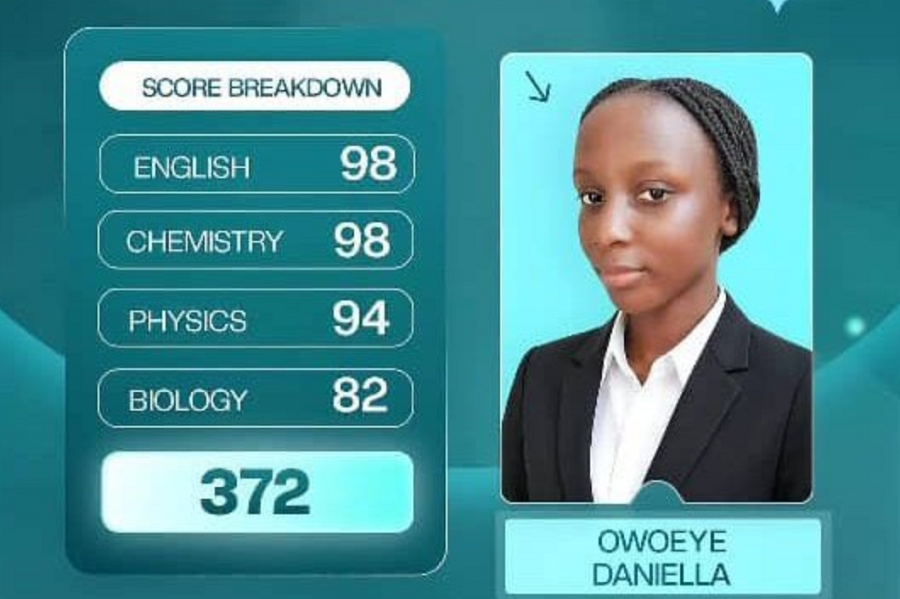
    Owoeye Daniella Jesudunsin from Ekiti State emerged as the highest scorer in the 2026 UTME with 372 out of 400.

    Owoeye Daniella Jesudunsin


    The candidate selected the University of Lagos for Medicine and Surgery.

    JAMB records also showed that Enwere Kingsley Ikenna scored 370, while Bamisile Ayomide Emmanuel recorded 369.

    Several other candidates scored between 367 and 368 in the examination year.

    2025

    Okeke Chinedu Christian from Anambra State set a new all-time record after scoring 374 in the 2025 UTME.

    During a press briefing, The JAMB Registrar, Prof. Ishaq Oloyede, described the result as “the best highest in the last one and half decades.”

    The score became the highest recorded since JAMB introduced the computer-based testing model.

    2024

    Three candidates jointly occupied the top position in 2024 after recording 367 each.

    The candidates were Olowu Joseph Oluwasijibomi from Ondo State, Alayande David from Oyo State and Orukpe Joel Ehijele from Edo State.

    JAMB data showed that less than one per cent of candidates scored 300 and above that year.

    2023

    Umeh Kamsiyochukwu Nkechinyere from Anambra State scored 360 to emerge as the top candidate in 2023.

    She attended Deeper Life High School in Mowe, Ogun State.

    Her performance later attracted public commendation from The Governor Of Anambra State, Chukwuma Soludo, who offered her a scholarship.

    2022

    Adebayo Eyimofe Oluwatofunmi from Ekiti State recorded 362 to top the 2022 examination.

    JAMB documents listed the candidate among the best-performing students nationwide for that admission cycle.

    2021

    Monwuba Chibuzo Chibuikem scored 358 to lead all candidates in 2021.

    He later gained admission to study electrical, electronics and communications engineering at the University of South Florida in the United States.

    2020

    Maduafokwa Egoagwuagwu Agnes from Anambra State recorded 365 in the 2020 UTME.

    The score stood as the highest in the CBT era until it was surpassed in 2025.

    She later studied Mechanical Engineering at Duke University in the United States under the Karsh International Scholarship.

    2019

    Ezeunala Ekene Franklin scored 347 at the age of 15 to emerge as the highest scorer in 2019.

    He graduated from Meiran Community Senior High School in Lagos.

    His age made him one of the youngest candidates to top the national examination.

    2018

    Galadima Israel Zakari from Borno State scored 364 in the 2018 UTME.

    The result ranked among the strongest performances recorded during the CBT era.

    JAMB records confirmed the score as the highest for that examination year.

    2017

    Akingbulugbe Precious Ayomide emerged as the best-performing candidate in 2017 after scoring 353.

    Although the result received limited publicity at the time, it was later confirmed in JAMB’s historical records.

    2016

    Two candidates shared the top position in 2016 with identical scores of 359.

    The candidates were Akenbor Adesuwa Osarugue from Edo State and Anonye Victory Emenike.

    Adesuwa later studied Medicine at the University of Benin, while Anonye pursued Medicine and Surgery at the University of Jos.

    2015

    Ilukwe Lottachukwu Geraldine emerged as the highest scorer in 2015 with 332.

    She attended Loyola Jesuit College in Abuja.

    She later studied law at the London School of Economics and Political Science before becoming a legal practitioner and consultant in the United Kingdom.

    2014

    Onomejoh Princewill scored 299 to top the 2014 UTME.

    He later graduated from the University of Benin with a first-class degree and emerged as the best graduating student in his faculty.

    2013

    Olise Israel Chukwunalu became the first candidate to top the CBT-era UTME after scoring 299 in 2013.

    He secured admission to study Medicine and Surgery at the University of Ibadan.

    He later qualified as a medical doctor, marking the beginning of a new era in JAMB’s computer-based examination history.

  • JAMB UTME 2026 Highest Scores: See the Top 11 Candidates

    JAMB UTME 2026 Highest Scores: See the Top 11 Candidates

    The Joint Admissions and Matriculation Board (JAMB) has unveiled the top-performing candidates in the 2026 Unified Tertiary Matriculation Examination (UTME), with an aspiring medical student emerging as the overall best.

    Here is a list:

    Owoeye Daniella Jesudunsin – 372

    State: Ekiti

    First Choice: University of Lagos (UNILAG)

    Course: Medicine and Surgery (MBBS)

    Enwere Kingsley Ikenna – 370

    State: Imo

    First Choice: Nile University of Nigeria

    Course: Computer Science

    Bamisile Ayomide Emmanuel – 369

    State: Ondo

    First Choice: Federal University of Technology Akure (FUTA)

    Course: Software Engineering

    Olabiyisi Olanrewaju Oluwatimileyin – 368

    State: Oyo

    First Choice: Pan-Atlantic University

    Course: Mechatronics Engineering

    Victor-Onyeka Daniel Ifeanyi – 368

    State: Imo

    First Choice: University of Port Harcourt (UNIPORT)

    Course: Electrical/Electronic Engineering

    Osagiobare Daniel Osaherumwen – 368

    State: Edo

    First Choice: University of Benin (UNIBEN)

    Course: Mechanical Engineering

    Ademiluyi Adebowale Anthony – 368

    State: Osun

    First Choice: Obafemi Awolowo University (OAU)

    Course: Computer Engineering

    Azike Kenechukwu Anthony – 368

    State: Anambra

    First Choice: Afe Babalola University (ABUAD)

    Course: Software Engineering

    Offorike Michael Okechukwu – 367

    State: Abia

    First Choice: University of Ibadan (UI)

    Course: Computer Science

    Adebisi Eniola Sonari – 367

    State: Ogun

    First Choice: Covenant University

    Course: Computer Science

    Umukoro Gift Oghenevovwero – 367

    State: Delta

    First Choice: Pan-Atlantic University

    Course: Electrical/Electronic Engineering