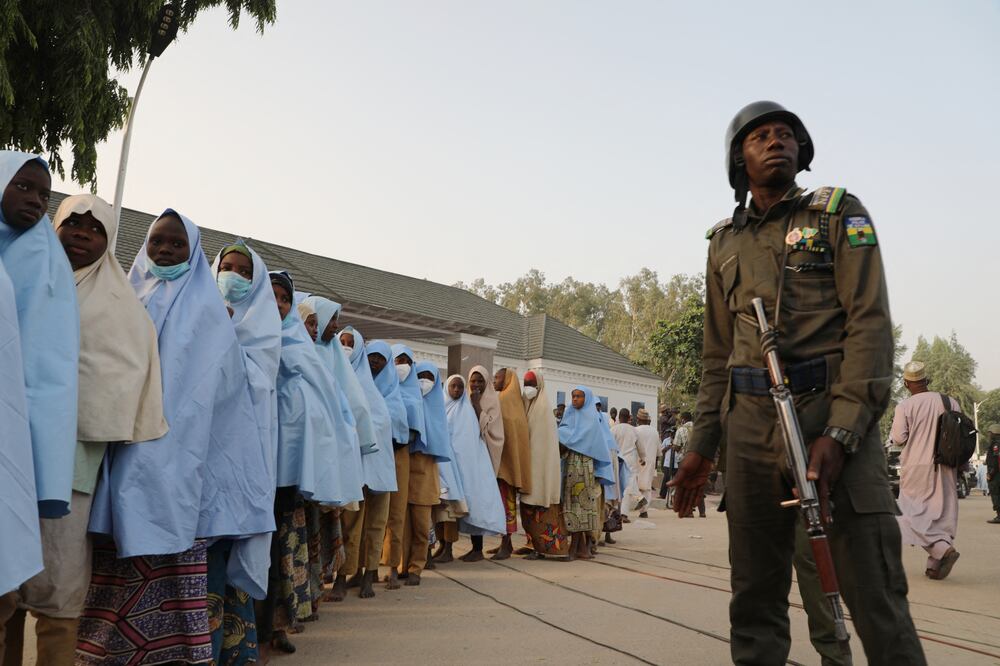
As Major General Rabe Abubakar was lowered into the ground at Gidan Dawa Cemetery, Katsina, a crowd of family, comrades, officials and well-wishers stood in final salute.
Recall that the retired soldier, taken captive with his wife on the Katsina–Matazu road on May 30, 2026, was buried at 6:00 p.m. opposite his home following funeral prayers attended by hundreds.
11 things you probably didn’t know about deceased ex-Army spokesman, Retired Maj Gen Rabe Abubakar
He was born on 7th of April, 1965 in Batsari Local Government Area, Katsina State.
He attended primary and secondary schools in Katsina State.
He earned a Bachelor of Arts in History at a Nigerian university (yet unknown).
He was commissioned into the Nigerian Army as a Second Lieutenant in 1989.
He rose to the rank of Major General in the Nigerian Army.
In August 2015, he took over as Defence Spokesman from Maj-Gen Chris Olukolade.
He served as Director of Defence Information, Defence Headquarters, from 2015 to 2017.
As DDI, he was one of the key voices communicating military operations, counter-terrorism, and security updates to the public during the Boko Haram insurgency.
He emphasized media synergy and civil-military relations in his briefings.
On 6 March 2017, Maj-Gen John Enenche replaced him as Defence Spokesman.
Rabe Abubakar was then posted as Director of Information Management, Department of Civil Military Affairs, Army Headquarters.
KOGI, NIGERIA — Troops from the 12 Brigade Nigerian Army have successfully rescued two kidnap victims following a swift counter-operation in Egbe, Yagba West Local Government Area of Kogi State.
The incident began late Wednesday, June 3, 2026, when armed terrorists invaded a residence near Solid Rock School in Ijalu, Egbe, abducting five members of the same family.
Scene of rescueMother and child after rescue
In a rapid response, army troops partnered with the Vigilante Group of Nigeria (VGN) to track the criminals along their escape route. Under intense pressure from the pursuing security forces, the terrorists abandoned two of the hostages—Mrs. Adekemi Idowu and her six-month-old infant—near the Oro axis before fleeing into the bush.
While the rescued mother and child have been safely returned home, the military confirmed that aggressive search-and-rescue operations are still underway to locate the remaining three family members and apprehend the kidnappers. The Nigerian Army has urged the public to assist by providing timely, credible security information.
Security experts have linked the interception of 43,750 liters of Premium Motor Spirit (PMS) to increased insecurity in Kwara State, citing fuel smuggling as a contributing factor.
Recall that the Nigeria Customs Service officials intercepted 43750 liters of Premium Motor Spirit (PMS) along the Niger/Kwara axis.
National Coordinator of Operation Whirlwind, Deputy Comptroller, Abubakar Aliyu disclosed that the seizure was carried out in response to credible intelligence aimed at disrupting illicit petroleum distribution networks.
Aliyu stated that the operation resulted in the seizure of 1,510 jerry-cans of 25 litres each and 30 drums of 200 litres, for a total volume of 43,750 liters and an estimated duty paid value of N43.75 million.
According to Aliyu, the products were intercepted at numerous flashpoints, including Kaiama, Shiya, Kenu, Boriya, Luma, Bokuru-Baruten, Ilesha-Baruba, Taberu, and Salla-Gwanara, which have been identified as active smuggling routes.
Abayomi Samson, a criminologist, told WITHIN NIGERIA that petrol smuggling fuels unrest and poses a direct threat to Nigeria’s economic stability and national security.
Samson argued that those who smuggle fuel are crime enablers who help or allow the black market economy to develop.
While expressing shock at the discovery of 43,750 litres by customs authorities, he urged security forces to step up efforts to eliminate fuel-smuggling networks throughout border areas.
Fisayo Adelakun, a security specialist, told WITHIN NIGERIA that petrol is smuggled out of Nigeria because it is cheaper than in Benin and Cameroon.
Adelakun informed WITHIN NIGERIA that a litre of petrol costs ₦1,680.32 in Benin Republic and ₦2,030.89 in Cameroon.
According to Adelakun, cheaper petrol in Nigeria encouraged fuel smuggling, which likely contributed to increased insecurity in Kwara towns.
Adelakun, who raised concern over fuel smuggling, argued that when fuel is trafficked, it depletes legitimate economic activity while fueling illicit ones such as violent conflicts.
He urged security authorities, particularly the police and DSS, to investigate the interception and apprehend all perpetrators, including their financial benefactors.
Sola Adetuberu told WITHIN NIGERIA that he believes many thousand litres would have eluded the watchful eyes of officials following the interception of 43,750 litres.
Adetuberu, while lamenting Nigeria’s vulnerable borders, revealed that surrounding towns and countries are remote, forested, difficult to police, frail, weak, and insecure.
He claimed that fuel smuggling empowers non-state actors because it is necessary for mobility.
According to the Ogun-born security specialist, bandits, kidnappers, and terrorists require petrol for motorcycles and automobiles, and illegal fuel keeps them running.
He went on to argue that collecting 43,718 gallons of petrol in Kwara is more than simply a customs victory; it is evidence that gasoline smuggling serves as a finance funnel for insecurity, leverages border weaknesses, and exacerbates economic misery, all of which can drive recruitment into criminal groups.
Boko Haram attacked Chibok school, abducted atleast 276 girls
According to Lawrence Durrel, history is an endless repetition of the wrong way of living.
History has a special significance in human existence. It doesn’t just preserve recollection of occurrences; occasionally, it also sparks contemplation on earlier occasions. We need to be aware of our history as we move forward.
WITHIN NIGERIA highlights one notable event that shaped April 15 in Nigerian history in an effort to raise awareness for the sake of education.
Boko Haram attacked Chibok school, abducted atleast 276 girls
On this day, April 14 in 2014, members of the Islamic jihadist terrorist group Boko Haram attacked the Government Girls Secondary School in Chibok, Nigeria, a majority Christian village.
A few hours prior to the raid, residents in Chibok had received phone calls from neighbouring villages warning them of the incoming attack, who had witnessed convoys containing armed insurgents driving in the direction of the town.
The kidnappers broke into the school, pretending to be soldiers of the Nigerian Armed Forces and dressed in matching military uniforms.
The militants also engaged approximately 15 soldiers based in Chibok, who were unable to stop the attack as the militants had superior numbers and firepower, and no reinforcements were sent by the Nigerian Military during the course of the attack.
A soldier and a police officer were killed during the course of the raid. The attack lasted for about 5 hours, during which houses in Chibok were also burned down.
According to accounts given by some of the girls, including a diary written by two of the girls (Naomi Adamu and Sarah Samuel) whilst in captivity, the militants had intended to steal a piece of machinery and were initially unsure what to do with the girls. They told the girls to get out and come with them.
Some girls were loaded into vehicles and the rest had to walk several miles until other trucks came to take them away, possibly into the Konduga area of the Sambisa Forest, a former nature reserve covering 60,000 km2 where Boko Haram were known to have fortified camps.
An unidentified senior military source believed that the girls may have been split up and placed in different Boko Haram camps, around Lake Chad, the Gorsi mountains and the Sambisa forest. 57 girls were able to escape by jumping from the trucks in which they were being transported.
Nigeria’s insecurity challenge is often discussed in military or political terms, but financial systems increasingly feature in official and academic assessments of how violent crime is sustained.
Security experts note that the circulation of large volumes of cash plays a significant role in kidnapping, armed robbery, banditry, election malpractice, and organised crime.
Several high-profile criminal investigations show that access to cash frequently determines the scale and persistence of violent activity.
Law enforcement records indicate that ransom payments, illicit arms purchases, and logistics for criminal gangs are commonly conducted through cash transactions.
Financial institutions occupy a central position in this ecosystem because they regulate withdrawals, transfers, and the movement of money.
Past incidents have highlighted vulnerabilities within banking operations, including weak monitoring of large cash withdrawals.
In multiple criminal cases, victims reported that attackers appeared to have advance knowledge of cash movements.
Security analysts argue that such patterns expose gaps in customer privacy protection and internal controls.
The Central Bank of Nigeria has repeatedly warned banks about the risks associated with excessive cash-based transactions.
Before the liberalisation of Nigeria’s financial sector, banking operations were smaller in scale and subject to stricter oversight.
Archival records show that early banking regulations emphasised ethical conduct and conservative lending practices.
Over time, deregulation expanded access to financial services but also increased exposure to abuse.
Financial crime investigators note that regulatory capacity did not always expand at the same pace as banking activities.
Several judicial proceedings have linked banks to money laundering cases involving public funds.
The former minister of petroleum resources, Diezani Alison-Madueke, was named in court documents relating to alleged election financing traced through commercial banks.
Audit reports on the Treasury Single Account revealed instances where government revenue remained outside authorised channels for extended periods.
Election observation missions have also documented the role of cash in vote-buying operations.
Images and testimonies presented before electoral tribunals have shown bulk cash movements ahead of polls.
Anti-graft agencies state that such transactions are difficult to trace once converted into cash.
Investigations into failed banks exposed insider abuses, unauthorised loans, and diversion of depositors’ funds.
Regulatory sanctions against institutions such as Skye Bank, Oceanic Bank, and Intercontinental Bank followed findings of governance failures.
Financial analysts describe these cases as indicators of systemic weaknesses rather than isolated misconduct.
Youth unemployment and poverty further complicate the security landscape.
Economic studies suggest that limited access to stable income pushes vulnerable groups towards illicit activities.
Criminal networks exploit this condition by providing quick financial rewards funded through illegal cash flows.
Researchers argue that insecurity thrives where money moves faster than oversight mechanisms.
Efforts to curb financial crimes have increased in recent years.
The Economic and Financial Crimes Commission has expanded collaboration with banks on suspicious transaction reporting.
The Nigeria Financial Intelligence Unit has introduced tighter thresholds for cash-based operations.
Despite these measures, enforcement challenges persist.
Banking sector data show that cash usage remains high compared to digital alternatives.
Analysts note that public trust issues, infrastructure gaps, and informal economic practices sustain cash dependence.
Security specialists argue that tackling insecurity requires financial transparency alongside policing and intelligence work.
Policies encouraging electronic payments are viewed as tools to reduce anonymity in transactions.
Stronger internal controls within banks are also seen as critical to preventing information leaks.
Regulators continue to emphasise customer data protection and staff accountability.
International best practices show that reducing cash reliance can disrupt criminal financing networks.
Countries that strengthened financial surveillance have recorded declines in ransom payments and illicit transfers.
Observers caution that reforms must balance security needs with access to legitimate banking services.
Financial institutions remain key stakeholders in Nigeria’s security framework.
Their role in monitoring funds positions them as gatekeepers against criminal financing.
Addressing insecurity, experts conclude, requires aligning financial regulation, law enforcement, and economic inclusion.
Without such coordination, cash-driven crime is likely to persist, regardless of military or policing efforts.
The link between finance and security underscores the importance of institutional accountability.
As Nigeria continues reforms, the banking sector’s compliance and transparency will remain under close scrutiny.
Ensuring that financial systems do not unintentionally enable violence is increasingly viewed as a national priority.
Kidnapping remained a major national concern in 2025 as many communities faced repeated attacks, abductions and rescue operations throughout the year.
The pattern of violence shifted from major highways to residential areas as armed groups continued to operate across many regions.
In January, several travellers were taken during an attack on a major road linking the northern corridor to the capital city.
Relatives of the abducted reported that the kidnappers made calls demanding large sums and warned families to respond quickly.
Security teams launched search operations around the surrounding forests, forcing the kidnappers to change their ransom demands as pressure increased.
By February, multiple communities in the central part of the country faced night raids where armed groups stormed homes and took residents away.
Some victims were held for long periods, while others regained freedom after coordinated rescue missions by security personnel.
Officials confirmed that patrols were expanded to reduce the movement of the gangs and to protect rural settlements.
In March, schools in the northern region became targets as groups invaded learning centres and removed students from classrooms and hostels.
The abductions triggered emergency responses by security units who began sweeping operations across nearby forests.
Part of the strategy involved dividing rescued groups into safe clusters to ensure that medical checks and documentation could be carried out without delay.
Families reported receiving repeated calls from the kidnappers demanding supplies and financial support to keep the victims in stable condition.
Authorities announced that search operations would continue until every missing student was accounted for.
In April, separate incidents in the South-East showed that criminal gangs were shifting towards smaller hit-and-run attacks along regional roads.
Travellers explained how armed men blocked routes, checked passengers and selected individuals believed to be capable of paying ransoms.
Security personnel later arrested several suspects after tracking communication devices linked to the abductions.
In May, a group of traders travelling from a market were taken during an ambush on a rural road in the North-Central region.
The rescue effort involved ground troops and aerial surveillance that located the movements of the kidnappers inside thick forest areas.
By mid-year, armed groups adjusted their approach again, targeting households and small groups instead of launching large-scale attacks.
Security observers linked the shift to increased patrols on major highways and improved coordination among local security units.
In June, communities in border areas recorded multiple incidents involving gangs moving across state lines to evade security pressure.
Local vigilantes and community groups joined formal security teams to assist in tracking the kidnappers through difficult terrains.
Air surveillance also became more active as authorities tried to understand routes used by the gangs to relocate victims.
In July, many rescued victims shared information about being moved frequently as gangs attempted to avoid detection from air and ground patrols.
Victims also described temporary shelters built with basic materials, suggesting that abductors relied on mobile camps rather than permanent sites.
Fresh operations were launched to dismantle these camps and restrict the ability of gangs to move freely.
By August, several states introduced new tracking initiatives and early-warning communication channels to help detect suspicious activities.
These platforms encouraged residents to report unusual movements quickly, especially in areas close to forests and isolated paths.
Local governments also expanded collaboration with community watch groups familiar with the terrain.
In September, another set of school abductions in the North-East triggered a nationwide response as security teams surrounded the affected areas.
Multiple rescue operations followed, leading to the recovery of several learners while search efforts continued for others.
In October, communities around the outskirts of the capital city experienced fresh incidents involving armed groups attacking isolated homes at night.
Authorities responded by increasing joint patrols and surveillance, focusing on routes commonly used by the attackers.
Residents demanded stronger long-term measures to protect neighbourhoods located near major forest belts.
By November, several coordinated rescue operations led to the recovery of victims across different regions after tracing digital communication signals and ransom trails.
Security agencies issued statements reaffirming their commitment to reducing the threat, while communities continued to call for faster interventions.
As the year progressed, the recurring incidents reflected how deeply rooted kidnapping had become and how challenging it remained to tackle.
The timeline also highlighted the emotional, financial and physical strain placed on families who had to navigate the uncertainty surrounding their missing loved ones.
The repeated attacks showed the need for long-term solutions, better information-sharing and stronger community-security cooperation.
Ajewole Baba Ijesa, veteran broadcaster and Duro Ladipo’s protégé who was humbled by predicaments
Prince David Adeniyi Ademokoya JP, popularly known as “Ajewole Baba Ijesa,” is dead. When a big elephant falls, two things are likely to happen—it either dies or stands up taller and more beautiful again. In all dimensions, Ajewole Baba Ijesa was a big elephant. He rose to stardom in his younger years. He witnessed the rising and setting of his own sun. As a big elephant, he fell and did not rise again. He had injuries that did not heal. The seasoned broadcaster, Aladamo maestro, and Duro Ladipo protégé who introduced Ijesa intonation and language to the national radio scene is no longer with us.
The sting of death has no melody. It is sharp, dangerous, and instant. There are two types of pain that do not go away easily. When you lose a loved one to the cold clutches of death, or when you fall and are unable to get up after numerous attempts. Prince David Adeniyi Ademokoya lost everything before he died. Donations, free medical care, and checkups could not rescue him from depression and frustration. He has gone home for eternal rest. If the Grim Reaper had waited for six more months, the veteran broadcaster would have clocked 78.
I was privileged to interview the deceased on July 10, 2023, after an Ilesa-born journalist, Isaac Haastrup, posted his picture on his Facebook handle and requested donations from his fans. I watched the short video, and I was perplexed. He was a legend in the music, theater, and broadcasting world. He was a man of many moments and reigned over two generations. Prince David Adeniyi Ademokoya had a drinking problem. Sadly, he did not drink beer like others. He prioritized alcoholic gins. Whenever they rescued him from the gutter and took him to the hospital for care, he would always find ways to resume the drinking habit.
Isaac Hastrup tried his best. But his efforts were not greater than Pa Ajewole Baba Ijesa’s encounters with life. He took him to the hospital for care. He bought food, drugs, and clothes from the funds he gathered for him. He facilitated people who painted his room and bought TV and cable networks to keep him busy and updated. He reconnected Prince Adeniyi Ademokoya to his roots, broadcasting at the Federal Radio Station in Ilesa.
I listened to Baba Ajewole on the radio, and he still had his voice. His distinctive voice, Ijesa intonation, and grit remained intact. But he eventually got lost because these interventions came too late. In physics, there is something known as the ‘breaking point’ of elasticity. Baba Ajewole Ijesa had reached a tipping point of melancholy and frustration. He turned to local gins to take his mind off his losses. Truly, life dealt with him.
These horrific experiences humbled him, from economic failures to kidnapping, massive farming losses, and marriage issues. He was overwhelmed and felt abandoned by friends and family who were supposed to support him.
During a conversation with him in 2023, Baba Ajewole said that his troubles were so severe that friends and family abandoned him. What happened? I queried during one of our talks, and he said that life happened. Indeed, the globe has numerous corners. May God not send us to one of the corners of the planet.
When I met Pa Ajewole Baba Ijesha at his father’s house, he was in desperate need of food, drugs, and comfortable living quarters. Although he had local gin in excess, he did not allow his lack of basic needs to override his desire. What was his desire? To build a house and dwell in it before he dies. Unfortunately, he died at his father’s house and was unable to develop the little land he had inherited.
Prince David Adeniyi Ademokoya, often known as “Baba Ijesa,” was born in December 1947. The 77-year-old veteran broadcaster and Ijesa-born studied acting and filmmaking under the guidance of the late Duro Ladipo. He has a remarkable ability for singing Adamo, a traditional music style primarily linked with the Ijesa people. He served as the previous Ilesa Rotary Club president and the Ijesa Social Elite Club’s former head of social and publicity. He was a former coordinator of the Oodua Peoples Congress (OPC). He worked as a freelance broadcaster for Western Nigeria Television (WNTV), the Broadcasting Corporation of Oyo State (BCOS), and the Osun State Broadcasting Corporation (OSBC). He featured in a number of well-known films, such as Oba Koso, Moremi, and Bi eyi o se, among others.
In an interview with WITHIN NIGERIA, the late Prince David Adeniyi Ademokoya disclosed that he married two wives, and they gave birth to ten (10) children—the first wife had eight, while the second wife had two.
According to the late Ademokoya, his life witnessed a sad turnaround after he had an accident on the Ilesa-Ibadan route.
“My car somersaulted more than three times, but I survived, and we continued to live happily. I was the coordinator of the Oodua Peoples Congress (OPC), Ilesa branch, and my team recorded a lot of successes, such as the arrest of armed robbers, among others.”
“Months after the accident, I was kidnapped and taken into a thick forest. I was beaten to a pulp and had a forceful spiritual bath in the forest. They made my life miserable until I luckily escaped from their midst. I was held captive for months. I had lost clients, contacts, and contracts before I got back home. That was the beginning of my downfall in life.”
He further disclosed that he started farming after he lost his media empire and contacts.
“As a substitute, I started farming. Years later, I began a rice business and purchased a pickup truck. It ended in ruins. I lost everything. I simply chose to keep a low profile, which caused depression and sudden love for local gins,” a rather sad Prince Adeniyi Ademokoya disclosed.
For every beginning, there’s always an inevitable end. Ajewole Baba Ijesa would forever be remembered as a young Ijesa man who rose to stardom and put his name on the national map of recognition. Late Ademokoya’s contributions to broadcasting, filmmaking, and community policing would forever be remembered.
A medical doctor who prefers to be anonymous has narrated how he escaped being kidnapped by gunmen suspected to be police officers in Oke-Aga, a neighborhood in Ilesa.
The doctor, who disclosed that he works at the Wesley Guild Hospital, stated that the incident happened on Friday around 10 p.m. after he had attended to a patient in the emergency ward.
He told WITHIN NIGERIA that he was driving home before he saw a white 18-passenger bus speeding in his lane and had to swerve or maneuver to the other side of the road to avert a crash.
He claimed that he swerved to the other lane because he thought the bus driver was sleeping.
According to the doctor, the bus was facing every lane that he was maneuvering in until the bus abruptly halted in front of my own vehicle.
While expressing his shock, the young doctor told WITHIN NIGERIA that he saw four people who alighted from the bus and were armed with rifles.
“They ordered me to park my car, which I did. Two out of the four struggled to open the door of my car, but they could not because I had used the central lock. The moment they approached the car, I quickly reversed the car backward, drove fast through the other lane, and headed back to the hospital”, as the doctor narrated.
The doctor, who decried that he has been living in shock and fear, told WITHIN NIGERIA that he does not feel safe anymore because he never expected to be attacked or threatened by uniform men in the dark.
“This is not my first time driving around 10 p.m. Whenever I have an emergency at the hospital, I always leave home without fear because my residence is not far from the hospital. One of the four people who approached me wore a police jacket, and he was cocking his gun as I made an attempt to swerve to the other lane”, he further narrated.
When asked about measures he had taken after the incident, the young doctor disclosed that he had notified the Divisional Police Officers (DPOs) of Division D ‘Bolorunduro’ and Division B ‘Ijamo’, respectively, the PPRO of Osun State Police Command, Yemisi Opalola, and the officials of the Department of State Security.
“I contacted the two DPOs and narrated the incident to them. They told me that those officers were not from their divisions. I have never experienced such a thing in my entire life. I don’t know if they are kidnappers or police officers. I’ve been following the route for a while, and I’ve never experienced such a thing. It is scary,” he added.
While appreciating God for saving his life, the young doctor appealed to security agencies, particularly the police, to investigate the matter, unravel the officers involved, and sanction them to serve as a deterrent to others.
The spate of kidnappings in Nigeria is becoming alarming. These mass kidnappings across the country have had devastating effects on the lives of victims and their families. According to data sourced from the National Security Tracker (NST), an initiative of the Council on Foreign Relations (CFR), and the Armed Conflict Location & Event Data Project (ACLED), 3,841 people were reported to have been killed by non-state actors, while 4,243 others were kidnapped in 2023.
Also, SBM Intelligence, a Lagos-based consultancy, estimates that 3,620 people were kidnapped in 582 incidents between July 2022 and June 2023, with a ransom demand of over ₦5bn ($6.5m). SBM Intelligence also estimates that 7,000 people have been kidnapped since President Bola Tinubu took office in May 2023.
In 2024, the kidnapping epidemic continues to increase. Data from Enough is Enough Nigeria, a coalition promoting a culture of good governance and public accountability, reveals that the country witnessed 256 kidnappings in January 2024. These kidnappings continued in February.
On the 13th of February, WITHIN NIGERIAgathered that Gunmen abducted at least 40 people in Zamfara state, the northwest region of the country. Also in the same month, 35 women are missing after kidnappers seized guests returning from a wedding in Northwestern. On the 5th of February, it was reported that travelers from Umuahia, Abia States, in two luxury buses, were kidnapped in Inyele Eteke in the Olalamaboro Local Government Area of Kogi State.
In March, the wave of kidnappings persisted, with reports of 60 individuals abducted by bandits in Buba village, located in the Kajuru Local Government Area of Kaduna State. Additionally, on Thursday, March 7th, the largest mass abduction from a school since 2021 occurred. Gunmen seized at least 287 school pupils in the northern town of Kuriga. In a brazen act during daylight hours, bandits stormed a government primary school and carried out this unprecedented mass kidnapping, marking the largest such incident in a decade.
Recall that in 2021, the Boko Haram terrorist group’s abduction of 276 schoolgirls from their dormitory in the town of Chibok caused international outrage, with 98 of the victims still missing, according to Amnesty International.
These Gunmen who kidnapped at least 287 school children on the 7th of March, demanded a ransom of 1 billion naira ($621,848) and threatened to kill all of the students if their demands were not met; a devastating incident.
Kidnapping continues to thrive in the country despite the increase in the security budget yearly, which calls for concerns. In 2021, the defence budget stood at N966.4 billion, which rose to N1.2 trillion in 2022 and then to N1.383 trillion in 2023. The Defence budget for 2024 is N1.647 trillion, about 5.7 % of the entire 2024 budget. Similarly, in 2021, N455 billion was budgeted for the Police, N559 billion in 2022 and N838 billion in 2023. In 2024, the Police budget stands at N969.6 billion.
Expert Reacts
A Security and intelligence consultant, Adams Abuh, has said that the increase in kidnapping is a result of the corruption that has eaten into Nigeria’s system, while also blaming the government for not taking a bold step to end poverty in the country.
“ I believe the greatest factor is the level of poverty in our nation, which is occasioned by massive or mitigated corruption in not only our politics but in governance. You are aware of how money meant for development, infrastructure, for organizations have been looted over the years. And we are faced now without a solid economic issue that cannot provide genuine employment for our teaming youth population in the country.
Most of these youth populations who have become talks in the hands of politicians and who sometimes are armed during elections turn against society to terrorize us. You are aware that some of these states or local governments don’t even pay salaries as they are supposed to pay. In these hard times, those areas we must look at, the government must look at” he said
According to him, proper judgment has not been melted on kidnappers caught over the years, leaving a negative effect on the country.
“Have we had kidnappers who have been condemned to death over the years? How many of them have been executed in the last 20 years in this country? They will kill our men people, but they are allowed to go free. I think that punishment needs to be brought back to being implemented to serve as deterrence for those who want to go into it” he added.
He therefore called for the government to provide adequate resources for security agencies and invest in technology, while also backing the call for state policing.
“ Government must continue to provide adequate resources in terms of remuneration for security agencies. Time is due for a review of their remuneration and other welfare benefits to enable them to be committed to what they are supposed to do. We should recruit massively. I want to believe that we are almost in the war period.
The strength of most of these organizations is inadequate to be everywhere, the way we want them to be. So we need to drill down, and we need to invest massively in technology and other equipment for them. Look at our forest, where these people are taken to, very poor, we don’t have technology that is overseeing them, We should be able to be in our comfort zone in a control centre and know what is happening in various forests across the country, this is what various technology can offer.
“let me use this opportunity to add that time is long overdue for the state police, whatever the likely misuse of the state police by some unscrupulous governors, should not hold us back because there are open spaces that the state police can occupy and support the Nigerian police for us to adequately provide security for our country,” he emphasized.
Kidnappers take over the Federal Capital Territory, Abuja
Obi, Atiku express concerns, charge government on immediate actions
FCT Minister, Wike reads riot acts on kidnappers
On January 9, 2024, six sisters alongside their father were abducted in the Federal Capital Territory Abuja.
The six sisters, aged from the early teens to 23, were taken hostage in the Abuja suburb of Bwari along with their father Mansoor Al-Kadriyar.
After their abduction, the gunmen later released their father, asking him to go get N60m as ransom for the release of his daughters before Friday, January 12.
Consequently, the hoodlums reportedly killed one of the six girls, Nabeeha, and dumped her body somewhere for her parents to bury.
The five sisters shortly before their abduction
However, following the reported killing of one of the victims by her abductors, there was an outrage and great sense of concern by Abuja residents and indeed of course many Nigerians.
WITHIN NIGERIA gathered that Nabeeha, a 400-level student of biological science, Ahmadu Bello University (ABU), Zaria, was laid to rest according to Islamic rites on Saturday, January 13.
The student’s death sparked outrage on X, formerly Twitter, with many users calling on security agencies to intensify efforts to rescue the remaining persons in captivity.
The abduction and subsequent killing of one of the sisters is the latest incident of kidnappings that has literally become a daily occurrence in the nation’s capital.
On April 26, 2023 a local government reportedly told Associated Press, AP that at least 29 people were abducted by gunmen in Federal capital territory, Abuja.
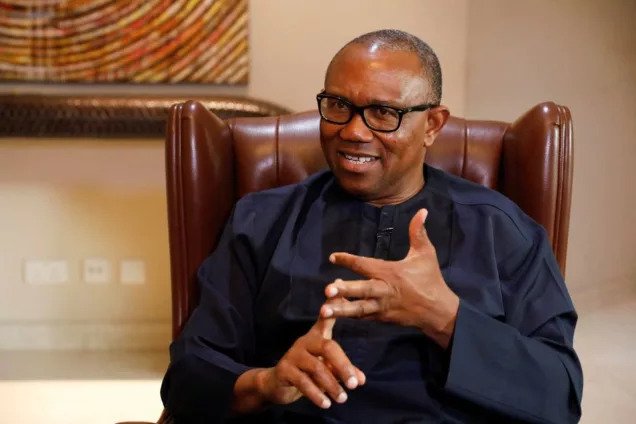
Obi: Condemns the incessant kidnappings
According to the report, the gunmen arrived after midnight on Tuesday and rounded up residents in Yewuti village, some who had been attending a local ceremony, said Daniel Ishaku, an aide to the chairman of the Kwali local council.
Narrating further, he said that “they took people from the playground and then went into the houses and took some people. They entered the bush with the people they carried walking on foot,” said Ishaku.
According to source, children were among those kidnapped and some of the hostages managed to escape.
Though the Federal Capital Territory has been having some security challenges including that of kidnapping, the April incident seemed to have opened a flood gate of kidnappings in the Capital Territory in recent time.
Sadly, lately no date passes without reported case of kidnapping in the nation’s capital.
Catalogue of the kidnappings in FCT Abuja
On Thursday, February 1, 2024 bandits reportedly abducted a director of the Federal Housing Authority, Federal Capital Territory (FHA), Aondo Ver, near a military base at Pambara in Bwari Area Council of Abuja.
Our source also revealed that Ver was abducted from his home, about 200 metres from the military base at 12.30 a.m. by gun bearing criminals.
It was gathered that this was happening at the same time the criminals, who abducted seven residents of Kuduru, also in Bwari Area Council in Abuja, placed N290 million ransom to release the hostages.
According to neighbours who confirmed Ver’s abduction, his abductors escaped through the bushes with their victim.
“The attack is still shocking to us. Our estate is very close to the military base here known as ‘camp’ at the entrance of Bwari, and there are also serving and retired military personnel living with us here, yet these bandits were bold enough to attack this place and kidnap Mr Ver,” one of the neighbours said.
A community leader of Kuduru, who did not want to be named, said the bandits had threatened to kill the captives if the N290 million ransom was not paid on time.
Earlier before then, on December 10, 2023 bandits numbering about 15 launched attacks on Gbaupe, a rural village behind ACO Estate Lugbe, along the Abuja Airport Road, where 12 people, including a 9-year-old boy and a 13-year-old girl, were kidnapped.
A villager told newsmen that the attack took place on Sunday morning
According to him, two of those abducted escaped as they were being arched into the bush behind the village.
One of the men taken away was said to have been dragged out without a shirt or footwear.
Although it was not the first time that criminals attacked Gbaupe, there had never been such a magnitude of kidnapping in the village.
WITHIN NIGERIA gathered that Men of the local Vigilante were said to have engaged the kidnappers but were overpowered due to superior firepower.
Investigations showed that kidnappers have been having a field day in the axis, which extends between Gbau, Kuje, Gauge, Pegi, Abaji, Keti, and Kwali, unchallenged for more than three years.
Economic, security implications of the kidnappings
With the escalating cases of kidnappings in the nation’s capital, it was revealed that house rents in upscale areas of, Abuja, have surged in recent times, a new report by SB Morgen (SBM) Intelligence says.
The report highlighted the deteriorating security situation in Nigeria’s capital and its tangible impact on the city’s residents.
Atiku Abubakar: Not happy with the situation
According to the report, there is a 10–50 percent increase in rent in upscale areas, driven by residents’ perceptions of enhanced safety. Conversely, rents in suburban areas, most affected by the security crisis, have declined.
At the same time, transportation fares have also spiked by 100-500 percent due to the prevailing crisis. Residents in the FCT are grappling with higher transportation expenses, particularly for intra-city travel.
The popular public transport service ‘Along,’ has become a hotspot for criminal activities, prompting residents to opt for more secure alternatives like Bolt and Uber. However, the surge in fuel prices has made these ride-hailing services relatively expensive.
Economically speaking, the current insecurity has led to a downturn in economic activities, especially in nightlife, such as night markets and recreational spots. Many city workers now prefer to head straight home instead of engaging in late-night activities due to safety concerns. This has led to a reduction of business revenue by 33 percent.
The report also stated that the surge in kidnapping incidents has left Abuja residents fearful for their safety. Incidents like the kidnapping of Mansoor Al-Kadriyar and his daughters in Bwari have highlighted the severity of the situation. Despite paying a ransom, one of his daughters was killed by the kidnappers.
SBM Intelligence reported that between January 2023 and January 2024, 283 individuals were abducted by bandits and kidnappers in Abuja, with areas like Bwari and Kuje being the most affected.
However, offering solution to the security challenges, the report recommended the redesign of the FCT’s political architecture, saying the security crisis results from unclear accountability under the current ministerial system. Introducing a governor or mayor with independent powers could enhance accountability and prompt proactive security measures.
Obi, Atiku react to the kidnappings
The 2023 presidential candidate of Labour Party (LP), Peter Obi, has said that insecurity is worsening in Nigeria, particularly the federal capital Abuja, despite the Bola Tinubu administration’s avowed promise to protect Nigerians.
Peter Obi said this in a statement shared via his verified Facebook page on Tuesday.
He said, “As terror attacks, banditry, kidnappings and violence continue to rage through the country, it is more concerning now with the surge of violence spreading through the Federal Capital Territory, Abuja.
“The recent killings of two abducted young girls in Abuja makes it more depressing and urgent. It is now time for we the leaders, to take all forms of serious measures to tackle the situation.”
The former Anambra governor said it was unfortunate that former President Muhammadu Buhari, in 2015, campaigned and won the presidential elections on three items – Security, Economy and Corruption (SEC) – but the situation worsened in all three areas in eight years.
“The present administration, on assuming office, promised to deal decisively with the same situation – Security, Economy and Corruption. Today, however, the situation is getting even worse than ever.
“At the Annual General Conference of the Nigerian Bar Association held in Lagos in August 2022, the then Vice Presidential Candidate, Sen Kashim Shettima categorically stated that if APC is elected, he as Vice President would be incharge of security, while the President as an expert in economy would handle the economy.
“Nigerians therefore now implore them to fulfil their campaign promises. Even if they do not achieve 100% results, we want to see 100% effort.
“It is now time to stop all forms of foreign trips from people in government, until we deal with the ugly situation facing us at home. No foreign investor or partner will like to invest in Nigeria, with the situation we now find ourselves in.
“We must make sincere efforts to end the spread of violence and insecurity in our nation, in order to make any meaningful progress,” Peter Obi said.
In the same vein,reacting to the recent kidnapping incidents, the Presidential candidate of Peoples Democratic Party, PDP Alhaji Atiku Abubakar in a tweet on Tuesday, January 30, 2024, wondered why the president would leave the country when kidnappers killed a nursing mother and grandmother in Abuja for failing to pay ₦90m ransom.
The former Vice President also mentioned the abduction of two monarchs in Ekiti by suspected herdsmen on Monday, January 29, 2024, to support his argument about the rising spate of insecurity in the country.
He, therefore, advised President Tinubu to step aside if the shoes are too big for him, adding that Nigeria needs a leader who would be available 24/7 to address the country’s “pervasive insecurity and collapsing economy.
“Tinubu is playing fiddle while Nigeria is drowning in the ocean of insecurity. To imagine that the Commander-in-Chief is on a so-called private visit while kidnappers kill a nursing mother and grandmother in Abuja for failing to pay ₦90m ransom and two monarchs in Ekiti, among other regular tragedies besetting Nigerians.
“If the shoes are too big for Emilokan, he should step aside. Nigeria does not need another Tourist-in-Chief. The country needs 24/7 leadership to confront the pervasive insecurity and collapsing economy,” his tweet read.
Government’s reactions
However, the Federal Government has vowed that it will make Abuja tough for the kidnapping rings in the Federal Capital Territory.
The Minister of the Federal Capital Territory, Nyesom Wike, said the Federal Government would not condone any form of bandit attack in Abuja.
Wike: No hiding place for kidnappers
Wike made this known recently at a town hall meeting he had with residents of the Bwari Area Council of the FCT.
WITHIN NIGERIA gathered that he convened the meeting following increasing reports of kidnapping for ransom and killing in the FCT.
It was also revealed that earlier before the meeting, Wike met with heads of security agencies in the FCT, top officials of the FCT Administration, and Chairmen of the six area councils, where he stated that the administration was aware of the security situation in the territory.
Speaking at the town hall meeting which was held in January, the minister said that President Bola Tinubu had instructed him to provide all that the security agencies would need, adding that it would no longer be business as usual.
Speaking at the meeting, Wike said, “Security is one of the key priorities of Mr. President’s administration. Yesterday, Mr President summoned a high-level security meeting, which includes all the Service Chiefs, the Minister of Defence, and my humble self, because of recent attacks, particularly in Bwari. And so, currently, it is one of the key priorities, that Mr. President’s Renewed Hope Agenda will want to face squarely.
“It is no longer going to be business as usual. Everything has to be done to protect lives and property. Without protection of lives and property, then we have no business in government. My coming here today is to assure you that we are very serious. All those criminals, bandits, enough is enough. We will do everything in our power to make sure that we will not allow this to happen again. That is why just this morning, Mr. President has given me approval, to provide everything required to the security agencies. And just like what Etsu-Bwari and Sarkin-Bwari said, it is not by merely talking, we are serious.
Security agencies will not have any reason to say that they are not equipped; we will provide everything required. I know how big Bwari is, I know that you have boundaries with three states: Niger State, Kaduna State and Nasarawa State. I know because these bandits were chased away from the Northeast, so they are making their way here, we will make it hot for them,” he said.
Speaking earlier, the Chairman of Bwari Area Council, John Gabaya, disclosed that the Council comprised 16 districts, and over 90 villages and hamlets, adding that the size and difficult terrain of the Council made the security challenges more difficult.
He therefore requested the provision of needed logistics to security agencies in the area, adding that they would require at least a vehicle and 7 motorcycles in each district for effective patrol and surveillance, while also appealing for training and retraining of hunters and villagers, engaged by the Council for their security.