Tag: UTME

  • JAMB Mop-Up Slip 2026 is Out — Print Yours Now Before the June 13 Exam

    JAMB Mop-Up Slip 2026 is Out — Print Yours Now Before the June 13 Exam

    If you missed the 2026 UTME and have been waiting on JAMB to say something, the wait is over. The Joint Admissions and Matriculation Board officially opened its portal on Sunday, June 7, 2026, for eligible candidates to print their 2026 Mop-Up UTME notification slips. The exam holds this Saturday, June 13. You have less than a week.

    This is not a drill. JAMB’s Public Communication Advisor, Dr. Fabian Benjamin, confirmed the announcement through an official statement on his verified X (formerly Twitter) handle, telling affected candidates to stop waiting for SMS alerts and go directly to the JAMB website.

    What Is the JAMB Mop-Up Exam — and Why Does It Exist?

    Not everyone who registered for the 2026 UTME got to sit it. Technical failures at CBT centres, biometric verification errors, and other system-related disruptions left a number of candidates stranded during the main April examination cycle.

    JAMB’s mop-up exercise is the board’s official remedy for that, a second sitting arranged for candidates who missed the main exam through no fault of their own. It is not an open re-sit. You cannot simply decide you want a better score and sign up. Only candidates that JAMB has internally verified and flagged as eligible will appear on the mop-up list.

    The board has been clear about this from the start.

    Who Is Eligible for the 2026 UTME Mop-Up?

    JAMB has defined eligibility narrowly. According to official communications, only candidates in the following categories qualify:

    • Candidates who experienced technical failures at their assigned CBT centres during the main UTME in April 2026
    • Candidates whose biometric verification could not be completed during the main examination — whether due to system errors or equipment failure at the centre
    • Candidates affected by examination centre disruptions that were documented and validated by JAMB

    If you simply did not show up, or you showed up late, or you sat the exam but are unhappy with your score, you are not eligible. The board has been explicit that this exercise is reserved for those who were unable to sit through circumstances they could not control.

    One important note already circulating online: JAMB will not publish a downloadable PDF list of names. The only way to confirm eligibility is to attempt printing the slip on the portal. If your name appears and the slip generates successfully, you are on the list. If you get a “not eligible” message, you were not captured, and the next step would be to contact JAMB directly or visit an accredited CBT centre with your registration documents.

    JAMB Mop-Up Slip Printing Portal — Step-by-Step Guide

    Printing the slip is straightforward. Here is exactly how to do it:

    1. Go to the official JAMB website: www.jamb.gov.ng
    2. On the homepage, scroll down to the e-Facility section and click on it
    3. Log in with your JAMB registration number, email address, and password
    4. Once logged in, look for and click “Print 2026 Mop-Up UTME Slip”
    5. Your examination notification slip will load — download it as a PDF
    6. Print it on A4 paper. If you do not have a printer at home, save it to Google Drive or your email and take it to a nearby business centre or accredited CBT centre

    Print at least two copies. Keep one for yourself and take the other to the exam venue on June 13.

    If you run into issues logging in or the slip fails to generate, do not contact third parties or random “JAMB agents” online. Visit your nearest JAMB office or accredited CBT centre in person with your registration details and a valid ID.

    What Your Mop-Up Slip Contains

    The notification slip is not just a formality. It is your entry document for the June 13 exam and contains:

    • Your assigned examination centre and address
    • Your examination date (Saturday, June 13, 2026)
    • Your scheduled time slot
    • Other specific instructions for the day

    JAMB’s statement was firm: “Candidates are strongly advised to print their slips well ahead of the examination date and familiarise themselves with their examination centres to avoid last-minute difficulties.”

    Knowing your centre location ahead of time matters more than most candidates realise. Traffic, unfamiliar routes, and late arrivals at JAMB exams rarely end well.

    This Is Your Last Chance — JAMB Has Said So Directly

    If there is one thing JAMB has repeated in every statement about this mop-up, it is this: there will be no third opportunity.

    The board confirmed that the June 13 mop-up examination is the final sitting for the 2026 UTME cycle. No further examination will be conducted after this exercise. Any eligible candidate who misses June 13 will have to wait for the 2027 admission cycle and start the entire process again.

    The delay in activating the regular 2026 UTME result slip printing, which JAMB had earlier paused, linking it to ongoing foreign examinations and mop-up preparations, also means many candidates are navigating two different anxieties at once. JAMB has assured that the result slip printing portal will be activated separately, with official notification to follow.

    Quick Facts: JAMB Mop-Up 2026

    Detail Information
    Exam Date Saturday, June 13, 2026
    Slip Printing Start Date June 6, 2026
    Portal www.jamb.gov.ng
    Button to Click “Print 2026 Mop-Up UTME Slip”
    Eligibility Technical failures / biometric issues during main exam
    Further Sittings After This? No — this is the final opportunity

    Frequently Asked Questions

    Can I use my phone to print the mop-up slip? Yes. You can log into the portal via your mobile browser, download the PDF, and then print it at a business centre or CBT centre. Just make sure the file is printed on A4 paper before exam day.

    My portal says “not eligible” but I genuinely missed the exam. What do I do? Go to the nearest JAMB office or accredited CBT centre in person. Bring your registration slip, proof of registration, and a valid ID. Do not attempt to resolve this through unofficial channels online.

    Does this mop-up exam use the same syllabus as the main UTME? Yes. The syllabus, subject structure, and scoring system are the same as the main examination. The question combinations will differ, but the difficulty level is expected to be consistent.

    Is there a fee to print the mop-up slip? JAMB has not announced any fee specifically for mop-up slip printing. The regular result slip (separate document) carries a fee of ₦1,500. Confirm current requirements on the official JAMB portal.

    Bottom Line

    The JAMB mop-up slip portal is live. June 13 is six days away. If you were affected by the technical issues that disrupted the April 2026 UTME, this is the moment you have been waiting for, and it will not come around again.

    Go to www.jamb.gov.ng, log into e-Facility, and print your slip today. Do not leave it until Friday night.

  • PERFORMANCE TRACKER: How UTME highest scores climbed from 299 to 374 in 13 years

    PERFORMANCE TRACKER: How UTME highest scores climbed from 299 to 374 in 13 years

    Every admission season in Nigeria produces stories of exceptional academic performance, but only a few candidates rise to the very top of the Unified Tertiary Matriculation Examination (UTME) conducted by the Joint Admissions and Matriculation Board (JAMB).

    From the beginning of the computer-based testing era in 2013, JAMB’s annual records have continued to reflect a gradual increase in the highest scores attained by candidates across the country.

    The progression has also highlighted changing trends in preparation methods, competition levels and performance standards among students seeking university admission.

    Official records released by JAMB show that the highest UTME score moved from 299 in 2013 to a record-breaking 374 in 2025.

    Below is a year-by-year review of the candidates who topped the examination between 2013 and 2026.

    2026

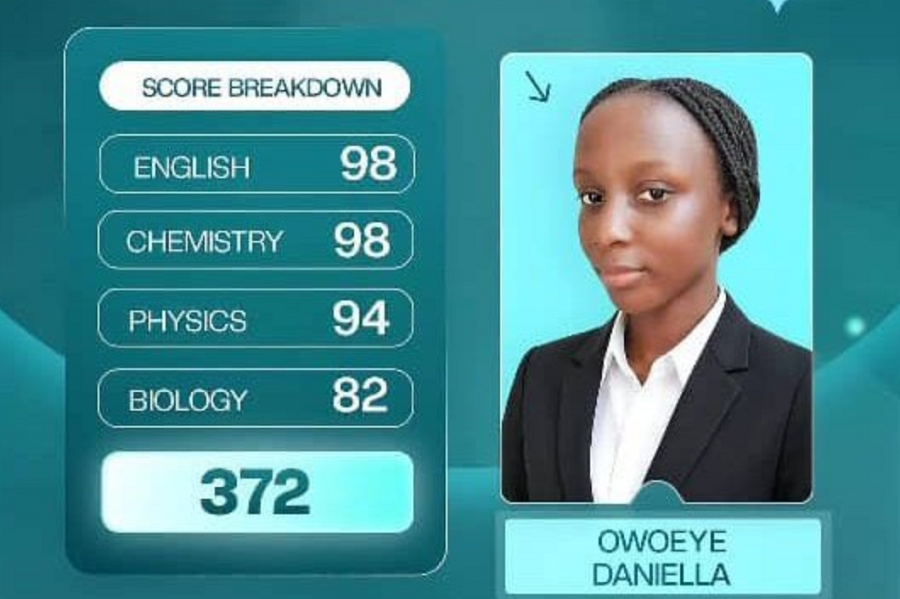
    Owoeye Daniella Jesudunsin from Ekiti State emerged as the highest scorer in the 2026 UTME with 372 out of 400.

    Owoeye Daniella Jesudunsin


    The candidate selected the University of Lagos for Medicine and Surgery.

    JAMB records also showed that Enwere Kingsley Ikenna scored 370, while Bamisile Ayomide Emmanuel recorded 369.

    Several other candidates scored between 367 and 368 in the examination year.

    2025

    Okeke Chinedu Christian from Anambra State set a new all-time record after scoring 374 in the 2025 UTME.

    During a press briefing, The JAMB Registrar, Prof. Ishaq Oloyede, described the result as “the best highest in the last one and half decades.”

    The score became the highest recorded since JAMB introduced the computer-based testing model.

    2024

    Three candidates jointly occupied the top position in 2024 after recording 367 each.

    The candidates were Olowu Joseph Oluwasijibomi from Ondo State, Alayande David from Oyo State and Orukpe Joel Ehijele from Edo State.

    JAMB data showed that less than one per cent of candidates scored 300 and above that year.

    2023

    Umeh Kamsiyochukwu Nkechinyere from Anambra State scored 360 to emerge as the top candidate in 2023.

    She attended Deeper Life High School in Mowe, Ogun State.

    Her performance later attracted public commendation from The Governor Of Anambra State, Chukwuma Soludo, who offered her a scholarship.

    2022

    Adebayo Eyimofe Oluwatofunmi from Ekiti State recorded 362 to top the 2022 examination.

    JAMB documents listed the candidate among the best-performing students nationwide for that admission cycle.

    2021

    Monwuba Chibuzo Chibuikem scored 358 to lead all candidates in 2021.

    He later gained admission to study electrical, electronics and communications engineering at the University of South Florida in the United States.

    2020

    Maduafokwa Egoagwuagwu Agnes from Anambra State recorded 365 in the 2020 UTME.

    The score stood as the highest in the CBT era until it was surpassed in 2025.

    She later studied Mechanical Engineering at Duke University in the United States under the Karsh International Scholarship.

    2019

    Ezeunala Ekene Franklin scored 347 at the age of 15 to emerge as the highest scorer in 2019.

    He graduated from Meiran Community Senior High School in Lagos.

    His age made him one of the youngest candidates to top the national examination.

    2018

    Galadima Israel Zakari from Borno State scored 364 in the 2018 UTME.

    The result ranked among the strongest performances recorded during the CBT era.

    JAMB records confirmed the score as the highest for that examination year.

    2017

    Akingbulugbe Precious Ayomide emerged as the best-performing candidate in 2017 after scoring 353.

    Although the result received limited publicity at the time, it was later confirmed in JAMB’s historical records.

    2016

    Two candidates shared the top position in 2016 with identical scores of 359.

    The candidates were Akenbor Adesuwa Osarugue from Edo State and Anonye Victory Emenike.

    Adesuwa later studied Medicine at the University of Benin, while Anonye pursued Medicine and Surgery at the University of Jos.

    2015

    Ilukwe Lottachukwu Geraldine emerged as the highest scorer in 2015 with 332.

    She attended Loyola Jesuit College in Abuja.

    She later studied law at the London School of Economics and Political Science before becoming a legal practitioner and consultant in the United Kingdom.

    2014

    Onomejoh Princewill scored 299 to top the 2014 UTME.

    He later graduated from the University of Benin with a first-class degree and emerged as the best graduating student in his faculty.

    2013

    Olise Israel Chukwunalu became the first candidate to top the CBT-era UTME after scoring 299 in 2013.

    He secured admission to study Medicine and Surgery at the University of Ibadan.

    He later qualified as a medical doctor, marking the beginning of a new era in JAMB’s computer-based examination history.

  • JAMB UTME 2026 Highest Scores: See the Top 11 Candidates

    JAMB UTME 2026 Highest Scores: See the Top 11 Candidates

    The Joint Admissions and Matriculation Board (JAMB) has unveiled the top-performing candidates in the 2026 Unified Tertiary Matriculation Examination (UTME), with an aspiring medical student emerging as the overall best.

    Here is a list:

    Owoeye Daniella Jesudunsin – 372

    State: Ekiti

    First Choice: University of Lagos (UNILAG)

    Course: Medicine and Surgery (MBBS)

    Enwere Kingsley Ikenna – 370

    State: Imo

    First Choice: Nile University of Nigeria

    Course: Computer Science

    Bamisile Ayomide Emmanuel – 369

    State: Ondo

    First Choice: Federal University of Technology Akure (FUTA)

    Course: Software Engineering

    Olabiyisi Olanrewaju Oluwatimileyin – 368

    State: Oyo

    First Choice: Pan-Atlantic University

    Course: Mechatronics Engineering

    Victor-Onyeka Daniel Ifeanyi – 368

    State: Imo

    First Choice: University of Port Harcourt (UNIPORT)

    Course: Electrical/Electronic Engineering

    Osagiobare Daniel Osaherumwen – 368

    State: Edo

    First Choice: University of Benin (UNIBEN)

    Course: Mechanical Engineering

    Ademiluyi Adebowale Anthony – 368

    State: Osun

    First Choice: Obafemi Awolowo University (OAU)

    Course: Computer Engineering

    Azike Kenechukwu Anthony – 368

    State: Anambra

    First Choice: Afe Babalola University (ABUAD)

    Course: Software Engineering

    Offorike Michael Okechukwu – 367

    State: Abia

    First Choice: University of Ibadan (UI)

    Course: Computer Science

    Adebisi Eniola Sonari – 367

    State: Ogun

    First Choice: Covenant University

    Course: Computer Science

    Umukoro Gift Oghenevovwero – 367

    State: Delta

    First Choice: Pan-Atlantic University

    Course: Electrical/Electronic Engineering

  • BREAKING: JAMB waives UTME for education, agriculture courses

    BREAKING: JAMB waives UTME for education, agriculture courses

    The Joint Admissions and Matriculation Board (JAMB) says candidates seeking admission into education courses and non-engineering agriculture programmes will no longer be required to sit the Unified Tertiary Matriculation Examination (UTME).

    The examination body announced the decision in a post published on its official X handle on Monday during its ongoing policy meeting on admissions.

    “Candidates seeking admissions into Education Programmes and Agriculture non-Engineering Courses are now exempted from UTME,” the board stated.

    The decision signals a major adjustment to Nigeria’s tertiary admission system as the UTME has long remained the primary qualifying examination for admission into universities, polytechnics and colleges of education nationwide.

    JAMB’s annual policy meeting is convened to determine admission guidelines for tertiary institutions, including cut-off marks and other admission procedures.

    Although exemptions from the UTME already exist for direct entry applicants and a few special categories of candidates, the latest development is regarded as one of the widest concessions introduced by the board in recent years.

    The new policy is expected to impact candidates applying for education and non-engineering agriculture courses by opening up alternative admission routes through institutional screening processes and other qualifications.

    In recent years, education and agriculture courses have typically recorded lower cut-off marks compared to competitive programmes such as medicine, law and engineering.

  • Scored Low in JAMB 2026? 5 Ways to Enter Nigerian Universities

    Scored Low in JAMB 2026? 5 Ways to Enter Nigerian Universities

    A low UTME score doesn’t close the door, there are other ways to enter Nigerian Universities. As of the time of filing this report, JAMB released over 1,264,940 UTME results. While some candidates excelled, others scored below expectations. Nevertheless, a low UTME score doesn’t close the door on university admission. According to WITHIN NIGERIA, several alternative programmes still offer second chances through foundational or bridging routes into full-time degree studies.


    JUPEB / Foundation / A’Level Programmes

    First, these pre-university programs let you bypass UTME and gain direct entry into 200 level. Specifically, JUPEB is the most popular — a 10-month programme accepted by 70+ Nigerian universities.

    To qualify, you need 5 O’Level credits including English and Maths. Afterwards, most schools require 6–10 points for 200 level, whereas competitive courses like Law or Medicine demand 12+ points.

    Importantly, results don’t expire, although most universities prefer you use them within 2–3 years. Other similar options include IJMB, Cambridge A’Level, and school-specific programmes.

    Diploma Programmes

    Next, universities and polytechnics run diploma programmes that don’t require JAMB for admission.

    These include Part-time, Daily Part-time, National Innovation Diploma, and university diplomas.

    Upon completion, the diploma strengthens your chances of progressing into a degree in a related field.

    Pre-degree / Remedial Programmes

    Alternatively, many universities offer 1-year pre-degree or remedial courses for students with incomplete O’Levels or low JAMB scores.

    Essentially, remedial programmes fix O’Level gaps, while pre-degree prepares you for both JAMB and 100-level work.

    During the programme, you’ll take core subjects and must score ∼40% per subject with 75% attendance.

    However, you’ll still need to write JAMB, pick that school as 1st choice, meet the cut-off, and pass Post-UTME.

    If successful, you’ll enter 100 level at that university. Note that this option isn’t transferable, and it adds an extra year and cost.

    Still, it gives a second shot at competitive courses like Medicine, Nursing, Engineering, or Law.

    Part-time & Weekend Degree Programmes

    For working adults, part-time degrees offer evening/weekend classes over 5–6 years, sometimes 4 years.

    To apply, you need 5 O’Level credits, and some schools waive JAMB requirements.

    That said, courses like Law, Medicine, and Engineering aren’t permitted, and graduates don’t go for NYSC.

    Examples include UNILAG, UNIABUJA, OAU, UNIBEN, LAUTECH, Babcock, OOU, and other NUC-approved schools.

    Direct Entry for ND/NCE Holders

    Finally, if you already hold an ND, NCE, IJMB, or JUPEB certificate, you can apply for Direct Entry admission into 200 level — regardless of your UTME performance.

  • Benue Bus Attack: 12 JAMB Candidates Still Held by Gunmen After Exam Trip

    Benue Bus Attack: 12 JAMB Candidates Still Held by Gunmen After Exam Trip

    • Experts Blame Tinubu, JAMB Scheduling

    Palpable hush as bus passengers including students travelling for UTME examination abducted on the Makurdi-Otukpo road in Benue State remain in the kidnappers’ cave.


    Recall that on Wednesday night, unidentified gunmen attacked a Benue Links bus and kidnapped 14 people, including candidates for the ongoing Unified Tertiary Matriculation Examination (UTME) in Benue, which is organized by the Joint Admission and Matriculation Board.

    Despite claims that two out of 14 passengers abducted around 8 p.m. escaped, twelve (12) are still in the custody of kidnappers, raising concerns about their well-being and the security of the passengers, who are primarily young people kept inside the forest.

    WITHIN NIGERIA has learned that three passengers, including the driver, who escaped the bus attack on Wednesday night and were not kidnapped, were taken into custody by the police for questioning.

    Despite claims that two out of 14 passengers who were abducted around 8 p.m. escaped from captivity, twelve (12) are languishing in the custody of kidnappers, raising concerns about their well-being and security of the passengers being largely young people kept inside the forest.

    WITHIN NIGERIA learned that three passengers including the driver who escaped the bus attack on Wednesday night were taken into custody by the police for questioning.

    Ifeanyi Emenari, the Benue State Commissioner of Police, has assured that abducted passengers will be rescued.

    He disclosed that he is currently leading a search-and-rescue operation alongside other security forces to identify the victims and hunt down the kidnappers.

    He revealed that tactical teams and Divisional Police Officers have been dispatched to the region to lead an extensive investigation into the situation.

    Benue Links Nigeria Limited, the company that owns the bus, has not issued an official public comment regarding the incident, but reputable sources revealed that the driver was arrested for breaking company policy.

    According to the company, the driver broke a policy that bars all travelling after 6 p.m. owing to security concerns.

    “The driver took the bus without permission, picked up people on the road, and left without proper papers or clearance. He embarked on a late trip against company policy, jeopardizing the passengers’ lives,” the company said.

    As of the time of publication, neither the police nor the kidnappers’ families have formally accepted any ransom requests; however, security agencies and local vigilantes have been working tirelessly to free the passengers.

    Security experts have condemned the bus attack, expressing concern that disgruntled groups could target vulnerable targets and disrupt the country’s peace. While discussing with WITHIN NIGERIA, analysts expressed concern about the situation and noted that no preventive measures were taken to prevent it.

    Security expert Kunle Olajide has blasted the Joint Admission and Matriculation Board (JAMB) leadership for exposing students to kidnapping and attack.

    Olajide, in a phone conversation with WITHIN NIGERIA, criticized JAMB’s decision to schedule examinations early in violent states.

    According to Olajide, creating unique timetables or schedules for violent states might not have been a bad idea given what transpired last year during the SSCE Examinations.

    Olajide, while praising security agencies, encouraged them to step up efforts to secure the release of JAMB candidates so that they can be reunited with their families.

    Salewa Abdulrasak, while lamenting the country’s escalating insecurity, asserted that the gunmen are nasty, tyrannical, and insensitive for targeting JAMB aspirants, who are soft targets.

    Abdulrasak, who termed the country as a joke, revealed that she never believed the federal government, security agencies, and JAMB would not include the hardship of students and the security situation in states such as Benue in their timetable.

    According to Abdulrasak, the Benue bus attack is a disgrace to our security authorities, particularly the intelligence organizations, who are meant to have cautioned or supplied functioning intel for JAMB regarding the impending exams.

    “Students are soft targets. During the JAMB examination, they travel early. Gunmen knew their parents would swiftly pay a ransom to preserve their lives and avoid missing the academic year, therefore preventive precautions were not taken,” said a concerned Abdulrasak.

    Kayode Ogunsemi, a human rights campaigner, sharply criticized the Benue bus attack, calling it a terrible event.

    Ogunsemi, who chastised President Tinubu for failing to protect Nigerians, particularly women and children, accused JAMB management of endangering students’ lives by not considering violence-prone states.

    He also slammed JAMB management’s persistent silence in the aftermath of the bus attack, alleging that the examination body’s failure to issue a statement about the incident constitutes criminal negligence.

    According to Ogunsemi, every abducted passenger must be rescued, and JAMB must provide alternatives for these kidnap victims because they were not to blame for the occurrence that denied them access to write the examination.

    He asked Nigerians to avoid bogus news, stick to credible sources, and refrain from sharing unsubstantiated information that could imperil victims in detention.

    He also urged President Bola Tinubu’s administration to take the bull by the horns and avoid making false excuses or dealing with insecurity by showy words or lip service.

  • JAMB 2026 REGISTRATION: “Key Dates, Steps, and Requirements” – Everything You Need To Know

    JAMB 2026 REGISTRATION: “Key Dates, Steps, and Requirements” – Everything You Need To Know

    The Joint Admissions and Matriculation Board on Tuesday, January 13, announced the commencement of the sale of application documents for the 2026 Unified Tertiary Matriculation Examination and Direct Entry admissions for the 2026/2027 academic session.


    This was contained in a release signed and released to the media on Tuesday night by the Registrar, Prof. Ishaq Oloyede, and shared on the Board’s official X handle.

    According to the board, applications are invited from suitably qualified candidates for admission into tertiary institutions in Nigeria for the 2026/27 academic session.

    The board further disclosed that eligibility is tied to age, noting that “only candidates who will not be less than 16 years old by 30th September, 2026, are generally eligible to apply/be considered.”

    However, WITHIN NIGERIA reviews the photo-statement signed by the Registrar, Prof. Ishaq Oloyede, which was shared on the board’s X handle, and culls important details, particularly how to apply for JAMB 2026 without stress.

    Here is the breakdown:

    CREATION OF A JAMB PROFILE

    Interested applicants will send his or her National Identification Number (NIN) to 55019 or 66019 in the format (NIN 12345678901).

    He or she will receive a 10-digit profile code via SMS.

    PURCHASE of JAMB e-PIN

    Interested applicants will visit authorized banks, online payment platforms, or JAMB-approved CBT centers.

    Interested applicants should present his or her profile code and pay for the registration fee (N6,200 – #7,000).

    He or she will receive his or her e-PIN via SMS.

    A TRIP to a JAMB-APPROVED CBT Center

    Interested applicants will visit a JAMB-approved CBT center with your profile code and e-PIN.

    Interested applicants must provide personal details and O-level results and choose institutions and courses.

    Interested applicants must capture biometrics (10 fingers) and photographs.

    Print and keep registration slips for future use.

    REQUIREMENTS?

    Interested applicants must possess a valid NI.Interested applicants must have an active and functional phone number and email address.

    Interested applicants must have O-Level results (WAEC, NECO, or NABTEB).

    Interested applicants must be at least 16 years old by September 30, 2026.

    IMPORTANT DATES

    For UTME registration, every applicant must apply between January 26 and February 28, 2026.For Direct Entry registration, every applicant must apply between March 2 and April 25, 2026.

  • How to register for 2026 JAMB

    How to register for 2026 JAMB

    The Joint Admissions and Matriculation Board (JAMB) has unveiled the registration guidelines for the 2026 Unified Tertiary Matriculation Examination (UTME), detailing crucial steps candidates must follow, along with possible challenges. 


    The statement, announced on Sunday via JAMB’s official X handle, intends to help potential candidates prepare for 2026 enrollment.

    According to the announcement, “Candidates should ensure their personal details, including National Identification Number (NIN), email, and A-Level results, are accurate before generating a profile code.”

    The prospective candidates are urged to send their 11-digit NIN to 55019 or 66019 (for instance, NIN 00000011111 to 55019/66019).

    According to JAMB, once a profile code is generated, it can not be changed, and biodata is automatically retrieved from NIMC.

    The board explained that E-PINs must be purchased only from authorized channels, such as banks, online platforms, or vendors at the registration centers.

    “Candidates should make all necessary corrections with NIMC early and confirm that the changes have been reflected on their portal before registration (for instance, name, date of birth, gender, and state of origin).

    GSM numbers and email addresses are unique identifiers; they cannot be changed or shared and must be functional before registration,” the statement reads in part.

    HOW TO REGISTER FOR 2026 UNIFIED TERTIARY MATRICULATION EXAMINATION (UTME)

    ELIGIBILITY CHECK?

    All applicants must be at least 16 years old by the admission year

    All applicants must have at least five (5) credits in English and Mathematics (WAEC, NECO, NABTEB)

    All applicants must have a National Identification Number (NIN)

    Every applicant must have a unique and working email address and phone number.

    REGISTRATION PROCESS?

    Every candidate must make sure that their NIN is valid

    Every candidate must build a profile by emailing the NIN to 55019 or 66019

    Every candidate must purchase e-PIN at the rate of #7200 (UTME) or #5,700 (DE)

    Every applicant must visit the CBT Center, upload papers, and take biometrics

    Each applicant must print and maintain the slip for inspection.

    NOVEL?

    Every applicant must read Kabir Alabi Garba’s ‘The Lekki Headmaster’

    Every applicant should always check the official JAMB website (jamb.gov.ng)

    NOTABLE DATES?

    Every applicant must know that UTME registration begins on January 31, 2026 and ends on March 8, 2026

    Every applicant must be aware that Direct Entry (DE): Opens March 10, 2026 and closes April 7, 2026

  • JAMB: Should Age Be A Barrier? Experts Weigh In On University Admissions

    JAMB: Should Age Be A Barrier? Experts Weigh In On University Admissions

    The Joint Admissions and Matriculation Board (JAMB) on Wednesday, October 8, screened 176 underage candidates who scored high marks in the 2025 Unified Tertiary Matriculation Examination (UTME). 

    Recall that the official age for university admission in Nigeria is 18 years, although the National Policy allows entry from the age of 16.

    Findings revealed that a total of 41,027 candidates applied under the category of exceptionally brilliant underage candidates for the 2025 UTME, but only 599 scored 80 percent and above.

    Some underage candidates were reportedly disqualified for not meeting the same benchmark in their O-Level or Post-UTME results, leaving only 176 confirmed for final assessment.

    The screening was apparently carried out concurrently in Abuja, Owerri, and Lagos. The goal of the screening was to ensure that only outstanding and well-prepared individuals under the age of 16 were considered for admission to postsecondary institutions for the 2025/2026 academic year.

    WITHIN NIGERIA observed that there are differing opinions on whether underage students should be admitted to university education.

    Some suggested that underage pupils can benefit from accelerated learning possibilities, stating that early enrollment can give them a head start in their professions.

    Others argued that underage students may not have the emotional maturity and social experience to thrive in a university setting. They also worry about potential negative impacts on the student’s physical and mental health, as well as potential gaps in their social development.

    WITHIN NIGERIA contacted some Nigerians, particularly experts and those in academics, to share their views about the development.

    Aderemi Ogunmodede, a lecturer at the University of Ilesa, told WITHIN NIGERIA that it is an aberration for JAMB to screen candidates for university admissions.

    He stated that the university has autonomy either to admit or reject candidates for admission.

    He further stated that the UTME may not fully capture a candidate’s ability or potential, especially since some students perform poorly under standardized testing conditions.

    According to Ogunmodede, issues like computer-based test malfunctions, network failures, or errors in result processing can unfairly affect a candidate’s chances.

    He concluded that giving JAMB too much control can slow down the admission process and reduce institutional independence and flexibility.

    Eze Chidera, a public analyst and legal practitioner, while conversing with WITHIN NIGERIA, believes that age should not be a barrier to attaining certain educational heights.

    Chidera argues that any student that passes any exam already proves that he or she is academically sound, and such a student should be allowed to climb the next academic ladder.

    “Self-confidence and self-control are not affected by age. Vulnerability is also not defined by age. The claim that any child below 16 is vulnerable is not entirely true. Besides, the policy of denying students who pass the right exams into university is against the constitution under chapter 2 of the CFRN,” he concluded.

    Rasheed Adegoke, an IT expert and public analyst, told WITHIN NIGERIA that the concept of someone who has put in the effort to gain knowledge and understanding to sit for a tough examination like JAMB and pass it being labelled as underage is very strange and illogical.

    Adegoke argues that there is no empirical evidence that shows moral maturity is linked to age to automatically disqualify people below such a threshold.

    He stressed that it is unfortunate that such an arbitrary limit or barrier has been set for admission purposes.

    According to Adegoke, we should set standards that govern the level of attainment that must be met to classify a child as gifted, and stringent standards should be established in schools to prevent discretionary “double promotion” or skipping of a class year into fast-track completion.

    “We should also mandate civic, moral, and citizenship or other mandatory curriculum that must be taken by all and which must not be skipped under any circumstances. However, using age as an admission barrier or criterion isn’t something I personally subscribe to. I am yet to see what value it adds to our educational outcomes,” he concluded.

    Abidemi Adebamiwa, a journalist and public relations expert, praised JAMB for scrutinizing young candidates, especially because they had already been allowed to take the examinations.

    He argued that once JAMB opens the door for them to compete, it is only fair to properly access and guide them through the next step, claiming the screening in this case is not discrimination but inclusion done responsibly.

    Adebamiwa advocated that it should go beyond academics, stating that young minds entering an adult environment should be mentored properly.

    “Although their brilliance deserves recognition, they also need mentorship and emotional support to thrive. Screening them makes sense, but supporting them afterward is what will truly make the process meaningful,” he concluded.

    Lukoye Demola, a law teacher, told WITHIN NIGERIA that the Joint Admissions and Matriculation Board (JAMB)’s move to adopt screening processes for candidates under the legal age for university admission is, at its core, a positive initiative.

    The Ife-born legal practitioner further disclosed that the policy resonates with the fundamental educational and psychological readiness that is essential for succeeding in higher education.

    According to Lukoye, universities are tailored for individuals who exhibit a noteworthy level of maturity across three critical dimensions: intellectual, emotional, and social.

    “Allowing the admission of underage candidates, typically those under 16 years old, could subject them to excessive academic and social pressures that may obstruct their comprehensive development and overall well-being,” a rather concerned Lukoye said.

    By imposing this screening, JAMB is not only upholding strict academic standards, but also emphasizing the welfare of young learners, ensuring they are not overwhelmed in a difficult educational environment, he added.

    “Nonetheless, I harbor concerns regarding the practical implementation of this policy. Nigeria’s educational landscape is highly variable; many students experience accelerated advancement through private institutions, while others may face delays in their academic journey due to socio-economic factors or inadequate infrastructure.

    Sunday Charles Adeyemo, a medical doctor and academic enthusiast told WITHIN NIGERIA that he is in support of underage applicants being considered for university admission.

    According to Adeyemo, students who write JAMB UTME and pass should be good enough to be considered for admission.

    Adeyemo argued that Nigeria is a plural society with diverse ethnic groups, and maturation varies from one geopolitical zone to another; to peg the age of admission into university would amount to limiting the potentials of these young lads.

    He stressed that students might end up being tools for bandits and terrorists because an idle hand is a devil’s workshop.

    “In the UK, where such age restrictions exist, there are provisions for further education and apprenticeship programs in colleges sponsored by the government, which keep students busy until age 18. In a country where most universities often experience disruption in the academic calendar due to the ASUU strike, allowing these future leaders to start early won’t be out of place,” Adeyemo further disclosed.

    Josiah Ucheawaji told WITHIN NIGERIA that the screening is in order, especially if the country will avoid policy somersaults where the ‘goalpost’ is shifted when there is personal interest and then maintained with all strictness when there are no interests to protect.

    According to Ucheawaji, there are rationales for JAMB screening of underage candidates for university admissions. Some of the rationale is legal (Child Rights Act of 2003), which fixes adulthood at 18 years.

    The associate professor at Adeleke University disclosed that JAMB and NUC have jointly agreed on 16 years, which is 2 years below the stipulated 18 years of age.

    “I feel that the child rights act is to protect underage people from a lot of vices in the university setting. University education requires maturity in the affective domain, cognitive development, and social adaptation that many underage students may not attain”.

    “I also feel that JAMB and NUC are trying to align with global education norms, where most universities expect entrants to be around 17–18 years old with post-secondary school completion.”

    Wale Tijani, PhD, a lecturer and educator, told WITHIN NIGERIA that JAMB is entitled by law to conduct and regulate admission into tertiary institutions in the country.

    According to Tijani, the examination body, in line with the National Policy on Education and the regulatory framework of the Federal Ministry of Education, conducts exams and sets requirements for admission in the country.

    He, however appealed that the screening process should be fair and transparent and gives room for redress.

    “I believe the admission age into the university still stands at 16 (for exceptional students, though). Anyone below this age, as stipulated, should not be allowed into the system except on a rare occasion objectively. Such exceptionality must be objective and independently verifiable,” he added.

    Tunde Omole, a child advocate and education rights activist, told WITHIN that he does not subscribe to the idea of pegging the age of admissions of students into institutions of higher learning.

    He, however, differed in that some students are exceptionally gifted in learning and character and should not be denied the opportunity of progressing in their chosen course of study.

    “We have seen and read about exceptional situations in Nigeria and globally where some students are deemed to be underage but are excelling academically and regarded as geniuses, and they grow to contribute to the holistic development of humanity and society in their chosen field.”

    I will suggest that the policy should be reviewed and ensure that the purpose of putting it in place should not be a clog in the wheel of educational progress of our teeming adolescents and young people, he urged.

    Ayoade Adewopo told WITHIN NIGERIA that the recent decision by the JAMB to screen 176 underage candidates is a prudent and necessary measure that prioritizes the long-term welfare of these young scholars.

    Adewopo, who acknowledged that some students’ intellectual gifts are undeniable, further posited that academic prowess is only one facet of the readiness required for the demanding environment of higher education.

    According to Adewopo, university life presents significant social and emotional challenges, from navigating complex peer relationships and managing newfound independence to coping with academic pressure away from the support structure of home.

    “A screening exercise is not a punitive barrier but a vital diagnostic tool to ensure that a student’s overall development is in step with their cognitive abilities, thereby safeguarding them from potential psychological distress and social isolation that could derail their academic journey.”

    “Furthermore, this proactive approach by JAMB serves to protect the integrity of the educational experience for all students. Placing a chronologically and emotionally immature student into a lecture hall or a dormitory designed for older adolescents can create disruptive dynamics for both the individual and their peers.”

    The screening process allows educators to identify those exceptionally mature young students who are truly prepared, while also guiding others toward a more suitable transitional path, such as specialized foundation programs.

    “Ultimately, JAMB’s initiative should be applauded as a forward-thinking policy that champions holistic student success over mere procedural admission. By implementing this screening, the board is acting as a responsible guardian, making a crucial investment in the future of these gifted children.”

    Abioye Oyewusi, a lecturer at Adeleke University, told WITHIN NIGERIA that the law prohibiting underage admittance into tertiary institutions is good and should be appropriately enforced.

    Oyewusi stated that there is a required level of composure and maturity that is required for excellence and survival at tertiary institutions, which is missing from most underage applicants.

    “Having academically gifted but mentally and emotionally underdeveloped ‘kids’ roaming the corridors of our ivory towers opens the way for abuse and manipulation of these vulnerable children. The corrective step should start at the primary level. Schools at all levels must ensure students are of the appropriate age for each class grade.”

  • JAMB lifts suspension on printing of admission letters, university transfers, others

    JAMB lifts suspension on printing of admission letters, university transfers, others

    The Joint Admissions and Matriculation Board, JAMB, has announced the lifting of suspension it earlier placed on printing of admission letters, inter-university transfers among others.

    The board, in a statement, Sunday, by its Head of Media and Public Relations, Dr Fabian Benjamin, said; “all requests for printing of admission letters, inter-university transfers, condonement of illegitimate admissions and other processes for previous years which had been hitherto suspended would now be restored from Monday, 31st August 2020.”

    “To ensure that candidates who took the UTME prior to 2020, and who require certain corrections of their processes are accommodated, the Joint Admissions and Matriculation Board has lifted the suspension earlier placed on processes covering those years,” he said in the statement.

    According to the statement, “it is to be noted that most of these operations are only available at JAMB offices nationwide. Furthermore, as the Board is desirous of sustaining compliance with COVID-19 protocols, it maintains that 2020 UTME candidates desirous of these services will only be attended to through the Appointment Booking Platform which they could access online through their phones to secure a definite date and time for an appointment. ”

    “The Board urged all State offices to ensure that all clients comply with all existing COVID -19 protocols,” he said.

    The statement read in full: “To ensure that candidates who took the UTME prior to 2020, and who require certain corrections of their processes are accommodated, the Joint Admissions and Matriculation Board has lifted the suspension earlier placed on processes covering those years.

    “As you may be aware, the need to prevent overcrowding at its Computer-Based Test Centres and other partner facilities, in line with extant COVID -19 protocols issued by relevant agencies, led it to allow candidates to seek corrections and other processes only through the 2020 Unified Tertiary Matriculation Examination (UTME)or Direct Entry (DE) platforms. This measure had the intended effect of limiting the number of persons visiting the centres.

    “As government continues to ease the lockdown leading to the resumption of students in exit classes, the number of 2020 UTME candidates needing one service or another at the various centres has drastically gone down, thus, the Board has decided to open up its platforms to accommodate more requests especially from previous years.

    “Therefore, all requests for printing of admission letters, inter-university transfers, condonement of illegitimate admissions and other processes for previous years which had been hitherto suspended would now be restored from Monday, 31st August, 2020.

    “However, it is to be noted that most of these operations are only available at JAMB offices nationwide. Furthermore, as the Board is desirous of sustaining compliance with COVID-19 protocols, it maintains that 2020 UTME candidates desirous of these services will only be attended to through the Appointment Booking Platform which they could access online through their phones to secure a definite date and time for an appointment.

    “The Board urged all State offices to ensure that all clients comply with all existing COVID -19 protocols.”